Source: http://www.blueskyelectric.net/blog/tips-hiring-the-right-electrician/
electrical company electrical supplies electric repair contractor electrical electrical contractor in
Source: http://www.blueskyelectric.net/blog/tips-hiring-the-right-electrician/
electrical company electrical supplies electric repair contractor electrical electrical contractor in
 As a licensed electrical contractor in Miami and South Florida that has been in business for many years, we handle the entire spectrum of electrical services. While some smaller electrical companies may not be able to handle certain jobs or not have the staff or expertise to make it happen, we do it all!
Whether you are just looking to have some minor electrical work done in your new home, install lighting or put in a generator, we will get the job done safely and securely. Over the years, we have handled just about every type of job you can possibly think of. We work on commercial properties and residential. We can work with your developers and architects from the beginning of your project until the end to make sure you have the exact fixtures that will best suit your home or business. If you need commercial lighting for a restaurant, office building or hotel in South Florida, we can do it without a problem. Also, if you want to install a generator for your home or office, we specialize in that as well.
If you want to install some new lighting or wiring for your home, we will be happy to come by and give you a fair estimate for the work to be completed. You can check out our testimonials page for reports from happy customers and you can always look us with the better business bureau as well to see that we have an excellent rating. We have said it many times before but can never stress it enough, never trust a company that has a bad online reputation or no online presence at all….
If you have a project that needs an electrician in West Palm Beach, Boca Raton, Lighthouse Point, Fort Lauderdale, Hollywood, Parkland, Coral Springs, Aventura or South Beach, Call Southern Coast Electrical today!
Our Miami electricians are the best in the business and can handle electrical contractor work anywhere in the South Florida area!
 Knowing proper electrical safety is imperative for many reasons. One can become shocked, burned or in the worst case scenario a person can be electrocuted which can lead to death by not becoming knowledgeable about electrical safety. One should be aware of basic safety guidelines when working with or around electricity.
Here’s some tips from your San Gabriel Valley electrician….
Faulty wiring is a common cause of many electrical related accidents on a job site. For this reason one should always use all of the power tool equipment properly, because when it is misused it can damage the wires of the equipment. Power tools should never be picked up by the cords; this can weaken the wires which can eventually fray. Checking the power tools for cracks and damage to the cords can reduce the risk of shock.
When one has to use extension cords while working on a job site, the extension cords should be rated for the amount of power that is being used. If the voltage of the power tools that are plugged in to the extension cord is too high, the cord can become hot and lead to an electrical fire. It is also important that one does not plug in too many power tools at once to the extension cord because the end result could also lead to an electrical fire.
Three pronged plugs on any type of equipment are never to be altered to fit into a two pronged outlet for any reason. When a worker does this, it results in the grounding wire becoming unusable and leaves the worker that is using the equipment unprotected from stray electricity. If a two pronged outlet is the only one available outlet to plug into, one should use a three pronged adapter and make sure that the electrical wires are grounded before use.
Several tool companies know the importance of electrical safety. Many of the power tools that are commonly used on a job sites are double insulated. What this means is that the cord has extra protection that shields the electricity away from the worker using the power tool. Some of the most common power tools that offer the double insulation are nail guns and drills.
One should never stand in water when working with power tools or around any other type of electricity. Water acts as a conductor for electricity and the electrical current runs through the water. If a worker happens to be standing in the water, they can become electrocuted which will result in death. One should always remember that water and electricity do not mix.
electrical technician master electricians electrical construction electrical works electrical repairs
Lamp replacement guide 2013
Way back in 2007, Congress enacted legislation called the EISA (Energy Independence Security Act), stating that “all light bulbs be 25 to 30 percent more efficient by 2012″. This is our lamp replacement guide to help you figure out how to make the change to more energy efficient light bulbs (and linear and circline fluorescent tubes).
As of 2012, all phased out light bulbs and other lamp types are required to be replaced by energy efficient light bulbs, at the U.S. manufacturing and distribution level. This doesn’t mean you necessarily need run out right now and buy new replacement bulbs, it just means that when an old bulb or fluorescent tube burns out, you might be hard-pressed to find an old incandescent type light bulb or older T12 type fluorescent tube.
There are many simple ways to determine what type of replacement light bulbs or tubes you convert to, for your existing lamp holder/ fixture. The most common, ‘Edison’ or E61 screw base light bulbs will be replaceable by a simple trip to the hardware store and buying new replacement bulbs — whether these are moderately more efficient and expensive halogen type, triple-efficient compact fluorescent (CFL), or quadruple-efficient LED’s that also last 10x longer, or more.
Fluorescent lamp upgrades can be a little trickier, since they may require a coordinating ballasts upgrade. Depending on how many fixtures you will be re-lamping in the next year or two years, you’ll want to strategize your transition rather than spend money on intermediate technologies that become obsolete as fast as they’re installed. Expect to cut your lighting energy consumption by more than 20%, whatever change you make, and consider making a single change all at once, rather than pay a premium on labor for multiple service calls for as-it-fails type reactive maintenance.
Most recently, beginning January 2013, old style incandescent PAR lamps (specially-shaped bulbs with ‘paralax’ optical reflectors behind the filament, as one often sees in recessed lights) no longer may be manufactured for new distribution in the United States.
Larger lighting areas like commercial (office) and industrial work spaces may best tackle the transition period by looking forward to energy/cost savings as payment for the benefit of an upgrade to compatibility with widely-available modern lamp types. We recommend never replacing an out-dated T12 (1-1/4″ or 12/8″ diameter; phased out mid-2012) linear fluorescent lamp. Upgrading the ballast and switching to modern T8 tubes will pay for itself in a year or two. For some buildings or large lighting areas, total fixture replacement with T8 or T5 linear fluorescent type, or very-long-lasting LED-capable fixtures may be a smart investment in savings on longterm lighting costs, as well as reduced cooling costs from the more-efficient lamps/fixtures.
At the minimum, upgrading from T12 linear fluorescents requires a fixture retrofit (usually replacement of the transformer-starter, or ballast, that ignites the gas inside fluorescent tubes) to accommodate T8 (1″ or 8/8″ diameter) lamps. Since T12 fixture ballasts will be old and likely near the end of their life today, and the newer ballasts start rapidly and operate with lower flicker, it often makes sense to replace T12 ballasts preemptively, rather than seek out phased-out T12 lamps and wind up with a mix of T12 and T8 fixtures, as the T12 ballasts fail sequentially across a lighting area over a period of months.
There are plenty of online resources to help you make the switch from the old to the new, some are listed below along with a FAQ to help you trouble-shoot your own particular situation:
Natural Resources Defense Council Replacement Guide and Charts
Q: Will I be fined or punished for not replacing my bulbs?
A: No, there are no repercussions keeping old incandescent bulbs aside from the fact that manufacturers may not distribute the older lamp types in the U.S., and they may become increasingly expensive.
Q: Don’t the newer bulbs or fluorescent tubes cost more?
A: Often, they do. Yet when you factor in longevity and efficiency, the bulbs and tubes pay for themselves through reduced energy and re-lamping labor costs. See the NRDC article and chart listed in this posts Resources section.
Q: What if I don’t like the look of florescent light bulbs?
A: There are plenty of options such as halogen bulbs and LED lights that give off more of a natural light than a CFl light would.
Licensed Electrician Robert Monk Lamp replacement guide, Energy Efficiency for 2013 Copyright Robert Monk, 2012
Source: http://www.phillylicensedelectrician.com/lamp-replacement-guide-for-2013/
electrical repair commercial electric electric contractor contractor electric electrician job
 A large horse power Motor failed in the facility and the facility replaced the motor and the wiring between the motor and the starter. However, during Cooper Electric's Annual Gear Maintenance and Cleaning we found that the actual source of the problem was a bad electrical termination on the C phas, inside of the distribution gear, which was actually the cause of the large horse power motor failure. Had we not found this and they started up the new motor, in all likelihood they would have destroyed yet another new motor.
 Tags:
Tags: Del.icio.us | Facebook | TweetThis | Digg | StumbleUpon |
Source: http://cooper-electric.net/why-we-perform-annual-gear-cleaning/
electrical certification electrical inspection electrical maintenance electrician certification electrical contracting
 Every California home has electricity flowing through it and normally safe however, if you have young children or are planning to do work on you home, you must make sure you have some basic electrical safety training and electrical safety rules. Electricity is a part of modern society however without the proper precautions electricity can kill very easily. This article will give you some very basic electrical safety tips.
Small children love to learn by exploring and touching. Parents and caregivers must diligently remove any electrical hazards in their home and keep their children safe. First remove or repair any loose electrical lines. If you have loose electrical sockets or frayed wires protruding from the wall, you should have the issues fixed by your trained San Gabriel Valley electrician. Also, replace any frayed power cords on electrical appliances you use. In some cases you can have a frayed power cord repaired but you should also consider replacing the appliance completely.
After any electrical wiring issues in your home have been repaired, take some time to learn about electricity and what to do in the case of an emergency. When there are small children in your home you must know what to do in the case of an electrical emergency. Purchase a training DVD that will explain electrical safety in an easy to understand detail. If learning from a DVD is not for you, some communities offer electrical safety training for free through the electrical power company. The goal of learning about electrical safety is to not become an expert in electricity or electrical repair but to gain enough knowledge to be able to react in an emergency.
Now that you have training and the most pressing electrical hazards in your house resolved. Start childproofing your home. Cover all electrical sockets with plastic electrical socket covers to prevent your child from poking items into the sockets. Be sure that the covers you choose to use cannot be removed easily by your children and are large enough that they are not a choking hazard.
Finally, prepare for the possibility of an electrical fire by purchasing a fire extinguisher specially designed for electrical fires. Water should never be used on an electrical fire because the water has the potential to cause the fire to spread. Knowing about electrical safety means being prepared for the possibility of an electrical fire by purchasing a chemical fire extinguisher and checking the charge on your extinguisher yearly.
While chances are you will never need to use your electrical safety training or use your fire extinguisher the knowledge of electrical safety tips in the home is vital to protecting your children. Take the time to take electricity and electrical safety rule serious and your house will be happy and healthy for years to come.
“I might add a prediction—that the hydrocarbon energy age could still be young, even quite young. The much-hyped emergence of a new renewable energy era by mid-century is less our energy future than our energy past…”
I am honored to receive the [2002] Julian Simon award tonight. My thanks go to the Simon family and the Competitive Enterprise Institute for having this annual award to recognize and encourage new contributions in the “sustainable development” field that Simon pioneered.
My appreciation also goes out to a number of groups within the classical liberal “structure of production” that have supported my intellectual development over the last quarter century, and in particular the Institute for Humane Studies at George Mason University, the Cato Institute, and the Atlas Economic Research Foundation.
Julian Simon was very interested in energy and energy-environmental issues. I have identified six of his themes in this area:
The conclusion from the Simon worldview is that the energy Malthusians are wrong. The hydrocarbon-based energy economy is sustainable and becoming more so in market settings around the world.
I might add a prediction—that the hydrocarbon energy age could still be young, even quite young. The much-hyped emergence of a new renewable energy era by mid-century is less our energy future than our energy past when, indeed, renewables dominated the inanimate energy market. The next energy period is most likely to be the enhanced hydrocarbon era, marked by a technological progression whereby a variety of hydrocarbon energies have become almost perfect substitutes for each other in cleaner and cheaper ways.
The recent commercialization of oil sands and orimulsion is creating a whole new competitive field for crude oil. Uneconomic natural gas reserves can now be upgraded into super-clean oil products. Add this to new combustion technologies lowering emissions and innovations such as the hybrid (gas/electric) vehicles, and the renewable, hydrogen-based energy economy seems as remote today as it was decades ago.
Progress has been made in the very contentious energy debate, thanks in part to the intellectual and marketing efforts of Julian Simon. Paul and Ann Ehrlich in their 1996 book, Betrayal of Science and Reason, admitted that “depleting” energies were not becoming scarcer and the air was growing cleaner. The Ehrlichs’ also stated that global cooling was not the problem Stephen Schneider and others once thought. The problem now was officially global warming.
Yesterday, the high profile energy debate was between Julian Simon and Paul Ehrlich. Today, the high profile debate is between Bjorn Lomborg and John Holdren. Holdren is the eminent Harvard Professor who is upset that he and his fellow “scientists” have lost valuable time by having to refute Dr. Lomborg’s claims made in The Skeptical Environmentalist. (Check for yourself—http://www.sciam.com). Holdren now says that inquiry about oil depletion is “asking the wrong question.” He says that the debate is not about “running out of energy” but “running out of cheap energy” and “running out of environment.” Say what? We are not running out of cheap energy and we are not running out of environment, according to the facts.
Holdren, who once advocated “de-developing” the United States to reduce energy usage, now says, “Affordable energy in ample quantities is the lifeblood of the industrial societies and a prerequisite for the economic development of the others.” This is the high ground that must be seized with energy and energy-environmental policy. The energy-is-good view gives a new urgency to the views of Julian Simon and the energy realist school—those individuals and institutions that support affordable, plentiful, reliable energy for not only the energy rich but also the 1.6 billion energy poor.
Conclusion
Ideas have consequences, and facts do too. And facts are what Julian Simon always brought to the fore. The energy realists are winning the intellectual war with energy sustainability whether or not the old-school depletionists or new-school climate alarmists realize it. New forms of hydrocarbon energies are sprouting up for the 21st century and far beyond, and the human influence on climate is simply not producing the crisis signs that the alarmists warn us about.
The political war concerning energy sustainability is another matter. Many battles remain, but with the legacy of Julian Simon and organizations such as the Competitive Enterprise Institute, I am confident that we can win intellectual war and triumph in many more political battles than are lost. This is good news indeed given society’s growing need for and expectations of the “master resource.”
——————
These comments were given on May 22, 2002, at the Capital Hilton, Washington, D.C. in Washington, DC at the annual CEI dinner. Bradley is author of Julian Simon and the Triumph of Energy Sustainability (ALEC: 2000).
Source: http://www.masterresource.org/2013/02/energy-realism-optimism-simon/
electrical works electrical repairs find a contractor electrical installations electrical certification
“Global Building Automation & Controls Market (2013 - 2018): By Product (Lighting, Security & Access, HVAC, Entertainment, Outdoor, Elevator Controls, Building Management Systems (BMS)), Application & Geography (Americas, Europe, APAC, and ROW)”
That’s the title of a 369-page report with 112 data tables + 43 figures. It reportedly shows 11.2% compound annual growth from 2013 to 2018, taking the global market to $49.5 billion.
Price: $4,650 for a single user ($7,150 for a “corporate user license”)
– release.
Twin, or ‘two-for-one’, breakers allow the connection of two, separately-protected circuits in the space of one standard breaker. Two circuit overcurrent protective devices (COPDs) connect to a single leg of the phase bus bar in the breaker panel, effectively doubling the capacity of the breaker panel in terms of number of branch circuits connected. The total power capacity of the panel does not change with the addition of twin type breakers (and is largely unaffected by what breakers may be installed — a common misconception that can lead to the wrong conclusion that a panel is overloaded simply because the Ampere rating of all breakers adds to more than the main breaker Ampere rating).
Most breaker panels are rated to accept at least a few twin breakers. Some accept twins throughout the panel, and some accept no twins at all. The diagram inside the panel cover should indicate which breaker positions accommodate twin breakers (see photos).


Licensed Electrician Robert Monk Can I use twin breakers in my breaker panel? Copyright Robert Monk, 2012
Source: http://www.phillylicensedelectrician.com/can-i-use-a-twin-in-my-breaker-panel/
able electric auto electrical repair construction electrical electrical how to
“I might add a prediction—that the hydrocarbon energy age could still be young, even quite young. The much-hyped emergence of a new renewable energy era by mid-century is less our energy future than our energy past…”
I am honored to receive the [2002] Julian Simon award tonight. My thanks go to the Simon family and the Competitive Enterprise Institute for having this annual award to recognize and encourage new contributions in the “sustainable development” field that Simon pioneered.
My appreciation also goes out to a number of groups within the classical liberal “structure of production” that have supported my intellectual development over the last quarter century, and in particular the Institute for Humane Studies at George Mason University, the Cato Institute, and the Atlas Economic Research Foundation.
Julian Simon was very interested in energy and energy-environmental issues. I have identified six of his themes in this area:
The conclusion from the Simon worldview is that the energy Malthusians are wrong. The hydrocarbon-based energy economy is sustainable and becoming more so in market settings around the world.
I might add a prediction—that the hydrocarbon energy age could still be young, even quite young. The much-hyped emergence of a new renewable energy era by mid-century is less our energy future than our energy past when, indeed, renewables dominated the inanimate energy market. The next energy period is most likely to be the enhanced hydrocarbon era, marked by a technological progression whereby a variety of hydrocarbon energies have become almost perfect substitutes for each other in cleaner and cheaper ways.
The recent commercialization of oil sands and orimulsion is creating a whole new competitive field for crude oil. Uneconomic natural gas reserves can now be upgraded into super-clean oil products. Add this to new combustion technologies lowering emissions and innovations such as the hybrid (gas/electric) vehicles, and the renewable, hydrogen-based energy economy seems as remote today as it was decades ago.
Progress has been made in the very contentious energy debate, thanks in part to the intellectual and marketing efforts of Julian Simon. Paul and Ann Ehrlich in their 1996 book, Betrayal of Science and Reason, admitted that “depleting” energies were not becoming scarcer and the air was growing cleaner. The Ehrlichs’ also stated that global cooling was not the problem Stephen Schneider and others once thought. The problem now was officially global warming.
Yesterday, the high profile energy debate was between Julian Simon and Paul Ehrlich. Today, the high profile debate is between Bjorn Lomborg and John Holdren. Holdren is the eminent Harvard Professor who is upset that he and his fellow “scientists” have lost valuable time by having to refute Dr. Lomborg’s claims made in The Skeptical Environmentalist. (Check for yourself—http://www.sciam.com). Holdren now says that inquiry about oil depletion is “asking the wrong question.” He says that the debate is not about “running out of energy” but “running out of cheap energy” and “running out of environment.” Say what? We are not running out of cheap energy and we are not running out of environment, according to the facts.
Holdren, who once advocated “de-developing” the United States to reduce energy usage, now says, “Affordable energy in ample quantities is the lifeblood of the industrial societies and a prerequisite for the economic development of the others.” This is the high ground that must be seized with energy and energy-environmental policy. The energy-is-good view gives a new urgency to the views of Julian Simon and the energy realist school—those individuals and institutions that support affordable, plentiful, reliable energy for not only the energy rich but also the 1.6 billion energy poor.
Conclusion
Ideas have consequences, and facts do too. And facts are what Julian Simon always brought to the fore. The energy realists are winning the intellectual war with energy sustainability whether or not the old-school depletionists or new-school climate alarmists realize it. New forms of hydrocarbon energies are sprouting up for the 21st century and far beyond, and the human influence on climate is simply not producing the crisis signs that the alarmists warn us about.
The political war concerning energy sustainability is another matter. Many battles remain, but with the legacy of Julian Simon and organizations such as the Competitive Enterprise Institute, I am confident that we can win intellectual war and triumph in many more political battles than are lost. This is good news indeed given society’s growing need for and expectations of the “master resource.”
——————
These comments were given on May 22, 2002, at the Capital Hilton, Washington, D.C. in Washington, DC at the annual CEI dinner. Bradley is author of Julian Simon and the Triumph of Energy Sustainability (ALEC: 2000).
Source: http://www.masterresource.org/2013/02/energy-realism-optimism-simon/
 San Gabriel Valley generators are your run-to when there are power interruptions. Not having enough electricity could really make it hard for a household to work as normally as it would want, and this is why it’s important that you choose a generator that is most compatible for your home and your energy requirements. What should you consider when choosing a home generator?
If you’re thinking about installing a home generator by yourself, then you might want to take a step back and think twice about what you’re about to do. It could be very dangerous to deal with things that you don’t have much knowledge about. If you know a thing or two about generators, decide if they’re enough to help you safely and properly install it in your home. If you’re having second thoughts, it would always be better to have generators installed by your professional San Gabriel Valley electrician.
find a contractor electrical installations electrical certification electrical inspection electrical maintenance
[Update: Germany Stops Fighting Arithmetic and Ramps Up Construction of Economically Sensible Power Generation]
Two years ago we looked at the claim that wind generation can save money for power pool customers. We found that the supposed savings could be realized only if the elephant in the room – the above-market feed-in tariffs – were ignored.
In other words, the total amount spent on electricity purchases from a power pool was augmented by the additional amounts consumers pay to fund the feed-in-tariff (FIT). As long as wind generators can bid a low price but receive the higher FIT, then they have an incentive to underbid, thereby reducing pool prices, but not overall costs.
In addition, we looked at what an economically least cost system might look like in Germany over the next ten years. We found that it features more coal and lignite, keeps most nuclear plants operating, and builds new gas-fired plants.
The annualized differential in total costs for Germany between the no-nukes, no coal and lots of wind forecast pushed by Germany’s Greens and an economically least cost expansion plan amounts to more than $120 billion over ten years and perhaps as much as $200 billion. A lot of money, in other words.
Update: Since these two posts were published in 2010 Master Resource contributors have made a strong case that Germany’s overinvestment in wind and solar has harmed the nation financially without any compensating improvement in electricity supply. Compounding the overreliance on wind is the planned phase-out of the country’s nuclear power plants – baseload power that will need to be replaced with something other than wind.
It now appears that Germany has made peace with mathematics and economics, and not just in the energy sphere. The country has embarked on a major effort to build reliable power plants for the future.
Update: The burden on taxpayers and ratepayers really hurts in a sluggish economy. The renewable energy surcharge on German electricity bills now exceeds US 7¢/kWh, taking retail prices near US 20¢/kWh.
If a generation resource is a good investment for its developers then it must return a profit to them. In a normal electricity market this profit comes from supplying a segment of the demand (peak, intermediate/cycling, baseload) from a plant that is efficient technically and financially.
For existing plants and determinations of electricity costs in the here and now we can figure out the average cost of supplying electricity by calculating the weighted average cost of supply for each time period in the market every day. If the addition of one generation source raises this weighted average without improving service quality or reliability, then it is not economical and would generally not be chosen in a well-functioning market.
But what about the future? Electricity suppliers must invest large sums in new generation plants with the expectation that these plants will meet demand at the least cost. This cannot be known with certainty, and mistakes are made all the time, especially when government policy and rent-seeking drive investment choices.
Transmission network operators – those responsible for supply energy and power to grid customers and in charge of the “natural monopoly” part of the power business – try to reduce the risk attendant to future supply by figuring out the least costly way to supply power and energy to their customers in the future, including the wires to transmit the electricity. They have to take account of a long list of considerations: investment cost, fuel supply, emissions and licensing regulation, proximity to existing load centers and transmission nodes, transmission congestion – you get the idea.
The transmission system operator also has to pay attention to public policy – renewable energy mandates (“portfolio standards”), federal tax incentives (producer tax credits for wind and solar), fuel cycle limitations, feed-in tariffs, powerful politicians who do not want their vistas impaired – in a host of ways that directly impact their views of an optimal future generating system.
A wise investor in generation will first figure out what is economic to build? (ii) what are the physical constraints on the system? and (iii) what limitations will public policy put on otherwise least cost generation choices?
Let us imagine that we have a rather large and wealthy country to play with, one that currently has about 129 GW of installed generation capacity. Further, we can imagine that this wealthy country, responding to its powerful environmental movement, has decided to (i) phase out nuclear power; (ii) limit future coal power-plant operations; (iii) build a lot (a lot!) of wind generation plants;[ii] and (iv) bring in most of its gas supply from Russia at prices linked directly to refined oil products and crude (i.e., high and volatile).
Such a country would have a great deal of baseload generation capacity – coal + lignite + nuclear – perhaps half of total generation capacity and more than 60% of total kWh generated (US has coal + nuclear capacity of about 40% and current coal + nuclear generation is about 56% of total U.S. electricity output). Suppose further that green thinking had created incentives (FIT) that pushed wind up to about 20% of total nameplate capacity. Most of the country’s hydro generation and imports are soaked up by wind mirroring and shadowing. Exports have grown largely due to the need to dump excess wind generation that occurs when consumption is low – e.g., at night. The conventional wisdom solution for this overinvestment in non-producing electricity sources is to build additional transmission and pumped storage to disperse the electricity to some other place or time (kind of like the tall stacks theory of emissions reduction).
With all of that generation capacity essentially independent of fuel price trends it is no accident that the cost of generating electricity in Germania is (i) high; and (ii) not responsive to changes in oil and gas prices. At current world oil prices the average cost of electricity generation in Germania is about 8¢/kWh for total annual costs at generation of $56 billion.
With natural gas still expensive – kind of like burning oil but more efficiently – what does a least cost generating system for Germania look like in 2020, about the time the initial wave of early “teens” investments go on line?
The first thing you do is throw out the phase outs – keep the existing nuclear and efficient coal plants in operation until you have a more cost-effective substitute;
Second, phase out your highest cost oil plants – heavy fuel oil and old combustion turbines (2.6 GW)
Third, build some new, more efficient coal plants (3.8 GW) and CCGT units (4.5 GW), and nuclear (5.8 GW), reduce emissions per kWh by more than 30% in the new coal plants;
Fourth, operate existing wind (28 GW) but do not build new generation from that source.
Total annual generation cost in 2020: $54 billion at 7.5¢/kWh for average supply cost and 7.3¢/kWh for new supply, about 4% lower than current costs.
Update: Not much enthusiasm for new nuclear plants. In fact the Merkel government has stayed with the 2022 date for phasing out nuclear in the wake of the Japanese tsunami. Gas remains a troublesome option financially in light of the oil-linked prices for Russian supplies.
Everyone in Germany’s power sector knows that this least cost system is simply some renegade economist’s fantasy. Back in the “Real World of Energy Policy”, there are several important considerations that must be accommodated:
Stay clean – phase out at least 25% of older coal and lignite plants, make permitting of new coal plants difficult;
Stay green – stay the course on wind energy; and
No nukes – continue to phase out nuclear power. Build only enough new nukes to keep the Gauls happy.
{Gee, sounds like one of the leading contenders in the U.S. for Energy Secretary to replace the egregious Dr. Chu. But at least our guy, Thomas Steyer, coming from a hedge fund, will know a good scam when he sees it.}
Following this path will provide less electricity less reliably and at a higher cost for Germania – about $69 billion annually (at 9.9¢/kWh average cost and 10¢/kWh for new plant supply).
Less coal and lignite – existing units fall to 32 GW from 58 GW, new coal rises to 2.8 GW to make up for some of the lost legacy capacity;
Less nuclear power – existing nuclear capacity falls to 10 GW (from 19 GW), new nuclear capacity falls to 2.0 GW from 4 GW in the least cost case;
More gas – 15.6 GW of new CCGT, up from 4.5 GW in least cost case;
More wind – another 23.8 GW, for a total of 51.8 GW of wind, 32% of total nameplate capacity; and
More imports – enlarged interconnection with Benelux and Denmark/Norway is only cost effective way to shadow additional wind and meet peak demand.
Update: Germania is likely to continue to push some expansion of wind and solar, but now their preferences have moved toward more coal plants – 26 of them – to supply the country’s baseload electricity demand after the 2022 nuclear phase-out.
Easing off the green pedal a bit creates enough breathing room in Germania to generate a lot of clean electricity at a much lower cost. A more moderate program, even with 5 GW of new wind, can be done at a far lower cost with just a few adjustments:
Slow the phase out of existing coal and nuclear plants – keep 85% of existing coal and nuclear plants in operation in 2020;
Build new coal and nuclear plants – reduce emissions per kWh and burn less coal overall, and improve the efficiency and security of the nuclear fuel cycle;
Import more – let more medium term supply come from lower cost Benelux and Scandinavian suppliers to mirror/shadow wind and follow load.
Even current oil prices do not hurt as much as in the more aggressive scenario, with $110/bbl crude oil resulting in total annual costs of $58 billion at 8.1¢/kWh average cost and 7.9¢/kWh for new supply.[iii]
Update: New power plants under construction in Germany through 2020 total 41 GW. Fully 40% (16.5 GW) are coal or lignite. Gas accounts for more than 27% (11.2 GW) and wind has most of the remaining new generation at 20% (8.3 GW). Pumped storage fills out the plant mix at just over 3 GW (7%). Only those wind plants now under construction will be completed and no new wind plants are even in the planning stage. This generation expansion plan represents a triumph of mathematics over ideology.
In a world of unlimited wealth, where electricity can be stored and plants can be built instantaneously on a whim, a complete remake of a large power system seems feasible and even desirable to some. Back in the real world, where everything takes time, costs money and different sources of electric power are not perfect substitutes for one another, such ambitions are difficult to realize.
Germania set up too many targets on too short a time frame. The result was a series of conflicting mandates and constraints – close it down; no, we need it, keep it open; will the Jutes cooperate on supply? What happens to our gas supply when “bad weather” rolls in from the East (as it eventually does in Germania)?
A cleaner, greener power supply system is possible over a longer period of time at a far lower cost than a crash program. Orderly replacement of older coal plants with more efficient and cleaner new ones makes sense given the country’s resources, geography and demand patterns. As in the US a crash program to overhaul the system will ultimately force increased reliance on older, less efficient coal plants; it ignores microeconomic rationality for chimerical goals and wastes a lot of money and energy in the process. Or to paraphrase a revered Soviet philosopher, “you may not be interested in markets, but markets are interested in you.” Germania ignores market forces at its own peril.
Update: Germania has accepted the realities of power plant costs and performance limitations and has hedged its heavy renewable energy bets in favor of gas and coal. Even with this approach Germania may face poor returns from its gas plants as they will operate of lower than optimal capacity factors to buffer and shadow a higher wind generation capacity.
————————————–
[i] The simulations in this section come from a model of least cost generation that endogenizes some categories of risk. The model is called “Port Opt for Generation”. This program is a medium term optimization that includes time of day demand, wind shadowing, generator characterization, imports/exports and a variety of parameters with regard to coal, nuclear, hydro and HFO use and construction/phase-out. Different risk parameters, including oil prices, technology prices and operational characteristics can be modeled explicitly.
[ii] In spite of the constant claims to the contrary, wind’s contribution to output has never even approached the claimed levels of 25-30% for onshore wind and 35%+ for offshore. From 1995 through the end of the last decade Germany’s wind capacity factor has improved from 7.5% to just over 14% today. This means that the average kWh from wind costs about twice as much as the claimed figure, given the low output per installed MW of capacity.
[iii] The cost of new supply is below the average cost of supply by about 7% for this moderate scenario, while the “Green” future shows new supply above average cost by about 2-3%.
Source: http://www.masterresource.org/2013/02/germany-unaffordable-wind-20-cents/
Ketchup is just one by product that you can get from tomatoes. And the fresher it gets better it is. To give you freshly picked tomatoes, you might want to learn how to start growing them. But instead of just learning how long to grow tomatoes, it is ideal to learn the essentials on how to care for them as well. There are only a few rules to follow so better start learning them for you to reap the rewards of fresh harvest in no time.
Click Here For Juicy Delicious Tomatoes Instant Access Now!
As have said earlier, there are only a few basic steps in trying to grow your own tomatoes. And depending on how well you take each aspect in consideration, it will pretty much determine how long to grow tomatoes. You can always ask your neighbors if you seem to lack such information or you can find yourself a guide that you can now find online these days.
One of the things you might want to have in order to produce the best tomatoes is the proper lighting. As a matter of fact, the more you expose your crops to sunlight, the better they are going to get. However, make sure not to place them in a place where wind is abundant.
Another thing to consider is the soil you are planning to plant your tomatoes in. The best thing to do is to sterilize your soil from time to time. It is recommended to do so twice every season. What is important is that your soil is free from various infections or diseases that could affect your plants.
It is also important to keep your soil moist at most times. These are just some of the things to consider. Why learn how long to grow tomatoes if you could only learn the best ways to care for them instead. Doing so will surely get you there – an unlimited supply of fresh tomatoes.
Click Here For Juicy Delicious Tomatoes Instant Access Now!
-
About the Author:
This author writes about Tomato Planting Tips at Juicy Delicious Tomatoes
Article Source

Source: http://reschelectrical.com/how-long-to-grow-tomatoes-juicy-delicious-tomatoes/
home contractors electrician jobs electrical installation contractors electric electric contractors
Source: http://www.blueskyelectric.net/blog/licensed-electrical-contractor-hiring-check-list/
Ketchup is just one by product that you can get from tomatoes. And the fresher it gets better it is. To give you freshly picked tomatoes, you might want to learn how to start growing them. But instead of just learning how long to grow tomatoes, it is ideal to learn the essentials on how to care for them as well. There are only a few rules to follow so better start learning them for you to reap the rewards of fresh harvest in no time.
Click Here For Juicy Delicious Tomatoes Instant Access Now!
As have said earlier, there are only a few basic steps in trying to grow your own tomatoes. And depending on how well you take each aspect in consideration, it will pretty much determine how long to grow tomatoes. You can always ask your neighbors if you seem to lack such information or you can find yourself a guide that you can now find online these days.
One of the things you might want to have in order to produce the best tomatoes is the proper lighting. As a matter of fact, the more you expose your crops to sunlight, the better they are going to get. However, make sure not to place them in a place where wind is abundant.
Another thing to consider is the soil you are planning to plant your tomatoes in. The best thing to do is to sterilize your soil from time to time. It is recommended to do so twice every season. What is important is that your soil is free from various infections or diseases that could affect your plants.
It is also important to keep your soil moist at most times. These are just some of the things to consider. Why learn how long to grow tomatoes if you could only learn the best ways to care for them instead. Doing so will surely get you there – an unlimited supply of fresh tomatoes.
Click Here For Juicy Delicious Tomatoes Instant Access Now!
-
About the Author:
This author writes about Tomato Planting Tips at Juicy Delicious Tomatoes
Article Source
Source: http://reschelectrical.com/how-long-to-grow-tomatoes-juicy-delicious-tomatoes/
electrical how to contractor contractors electrician in electrician
Source: http://www.blueskyelectric.net/blog/licensed-electrical-contractor-hiring-check-list/

Homeowners taking advantage of renewable energy can qualify for savings of up to 30 percent of equipment cost; rentals and second homes are not eligible for these Consumer Energy Efficiency Tax Credits.
Be sure to take a look at part 1 and part 2 of PGI’s 3 part series on 2013 Energy-Saving Tax Credits.
A fuel cell is device that converts the chemical energy from a given fuel into electricity through a chemical reaction with oxygen or another oxidizing agent. Enabling the use of hydrogen technologies to power your home, residential fuel cells offer a safer, cleaner and more efficient alternative to gasoline and fossil fuels. Residential fuel cells have the potential to revolutionize the way we power our homes and the nation– recently becoming a more affordable and practical approach to saving energy. To quality for the Fuel Cell tax credit, the system much meet an efficiency level of at least 30 percent and must have a capacity of at least 0.5 kW. This credit includes installation costs.
Apart from Fuel Cells, Solar Energy Systems, Geothermal Heat Pumps and Small Wind Turbines, tax credits may be available for the following:
For more information on 2013 Energy-Saving Tax Credits, visit the the Energy Star website.
Source: http://powergenerationinc.com/2013-energy-saving-tax-credits-part-3-of-3/
industrial electrical electrician training master electrician electrical business electrical technician
An investment in a good mattress can be quite high. To help protect your investment, it would be wise to add a mattress cover to your mattress. Depending on what one might need from a mattress, the mattress cover could help make your day. There are many reasons you should consider using this type of protection. These include protection and comfort
With a mattress cover you can protect your mattress from liquids. Spills can happen at any time. A mattress cover can help to protect your mattress from spills and allow you to keep your investment in the best shape possible for as long as possible. You can also protect your investment in a good night’s sleep from becoming a place where bacteria and other mites will grow and collect. Mould spores, allergens, and dust mites can be kept from making a home in your mattress with the application of a mattress cover. The best mattress cover will completely enclose your mattress to help prevent allergens from collecting. Dirt is another problem that many people have to deal with when they do not use a mattress cover. Even a brand new mattress will have some dirt and other contaminants on it before you apply the first sheet.
A mattress cover can also add to the amount of comfort a mattress can provide you. Some covers can be heated to help deal with the colder months of the year. You could think of this type of cover as the same as applying an electric blanket to your sleeping area. The heated mattress cover has the heating coils built into it and you can turn it on when you are getting ready to get some sleep. Imagine how much fun it will be to be able to be warm when you go to sleep during those cold nights. Many mattress covers also can be chosen that provide memory foam tops that can enhance your current memory foam mattress. With the addition of a foam pillow top, the cosiness will be greatly increased. If you choose this type of mattress cover, it often will lie on top of the mattress and allow you to increase your comfort easily and quickly.
A mattress cover can provide comfort, cosiness, and protection from many different elements that could reduce the lasting power of your mattress. With the right mattress cover, it should be possible to accomplish the goal of protecting your investment in your sleeping future for many days and peaceful nights to come.
-
About the Author:
Check out how you can protect your investment in a great night’s sleep with the perfect mattress cover from MattressCovers.co.uk. With a huge selection to choose from, everyone can find just the right mattress cover to help them protect their mattress.
Article Source
Source: http://reschelectrical.com/how-a-mattress-cover-can-make-your-day/
Source: http://blog.atselectricinc.com/2012/07/smoke-detectors-6/
electrical estimating licensed electricians residential electrician electrician company electrician tools
“Power density (W/m2) is perhaps the most revealing variable in energetics…”[1]- Vaclav Smil
It may be a bit of an exaggeration to say that understanding power density may be all the average person requires to put our energy sources and needs into perspective, but there is some merit in this argument. Unfortunately, this view of energy matters remains little discussed, probably because it appears rather academic.
This post attempts to overcome this by further illustrating the concepts. It will also demonstrate how industrial-scale wind and solar PV electricity generation plants fail to meet this important, high-level standard of performance for electricity sources required by mankind, particularly in developed societies, but increasingly in developing and even undeveloped societies.
This is even without taking into account:
(1) The persistent erratic (short term – minutes) and unreliable (medium to long term – hours to days) nature of electricity production that wind and solar PV provide; (2) their high costs; and (3) many other considerations described here.
This is not to diminish the importance of these other matters, but the contemplation of them all together is fairly elaborate and perspective is easily lost.
In summary, power density is the “gold standard” as a high-level pass/fail measure of an energy source’s value to humanity.
Power Density
Vaclav Smil introduced power density concepts to MasterResource readers in this series. As defined in his comprehensive book on the subject, Energy in Nature and Society[2], power density is watts per square meter (W/m2). It has two components:
Power density also serves as a characteristic of the user environment.
To some, this concept may seem irrelevant, possibly interesting only to academics. They might say: Why can’t we just deal in watts and watt-hours? The answer is that these alone are incomplete considerations and misleading in assessing the value of energy sources for human well-being and advancement.
To others, power density might appear to be too reductive or simplified a consideration. After all, is there not a large energy potential in wind and solar resources, and is this fact alone not enough to justify harvesting it? The answer is the amount of energy available is only one factor. The other, arguably more important, is the inherent capability of the energy source to provide the needed flow of energy, that is its power component, in relation to the earth’s surface required to harvest it.
To help clarify this, Figure 1 provides an introduction to the concepts and their relevance. This representation and the following charts are derived from information in Vaclav Smil’s book referenced above.
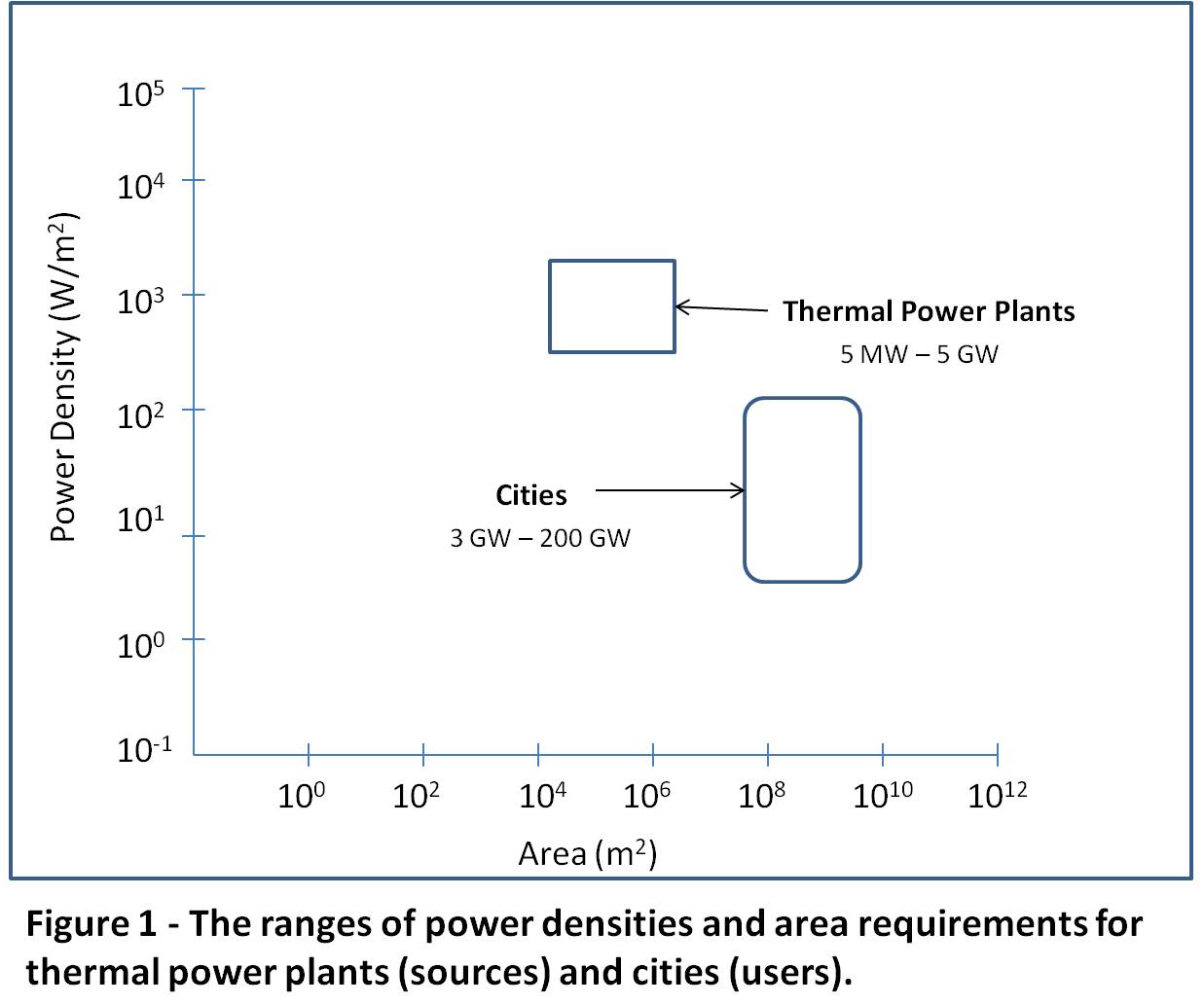
Figure 1 displays the ranges of power density versus land area required for individual instances of power sources and uses. The areas represented by the two boxes for thermal power plants (a set of sources), and cities (an example of the user community), approximately bound the ranges of instances of each. Heavy industry sites and high rise power densities can extend up to ten times the maximum value for that of aggregated cities, extending into the range for thermal power plants.
The process of determining the values is subject to a number of considerations affecting the size and positioning of the boxes shown, which are Smil’s, as represented and qualified by him. For example, for power plants the impact of the full fuel cycle is not included and will be discussed further below. Regardless of any discussion about the details, the values shown are useful for comparison and indicative purposes.
In the case of thermal power plants, the range in power density is from the hundreds of W/m2 to low thousands of W/m2. The range of ground surface required for a thermal power plant is in the order of 104 to 106 square meters. A simple calculation will show the approximate range of energy flux, or power. The energy in this case is electrical.
Low end = 500 (W/m2) x 104 (m2) = 5×10⁶ (W) or 5 MW
High end = 5,000 (W/m2) x 106 (m2) = 5×10⁹ (W), or 5,000 MW (5 GW)
For cities, the range in power density is from a few W/m2 to low hundreds of W/m2. The range of land surface covered is just less than 108 to over 109 square meters. This represents city sizes from roughly a hundred to a few thousand square km. In this case we are showing total energy needs, not just electricity.
Nuclear power plants, for the fenced plant site, can rate up to 4 kW/m2, or in general, similar to thermal plants.
I take the power densities and energy flows (or power) shown for sources to be on the basis of the installed capacity, ignoring the fact that some may not operate at this level on a full-time basis. A good illustration of this would be plants used in a reserve role. In the case of uses, cities for example, I take these to be averages over time and not representing peak values.[4] High power densities for energy sources relative to uses are necessary to meet growth, plant replacement, peak demands and reserve requirements without significantly expanding the land area requirements.
So, why is this so important?
Electricity’s Future
Given the projected growth in the world’s population and the needs of developing and undeveloped nations, we have to ensure we have the energy resources this entails, and in particular, be careful about how we evolve our electricity infrastructures and technologies to avoid self-inflicted setbacks. Otherwise, we could seriously restrict the needed advancement in human well-being. As societies progress, they become more complex and significantly increasing amounts of energy are required to sustain this complexity. From Thomas Homer-Dixon, director of the Waterloo Institute for Complexity and Innovation, in his paper “Complexity Science and Public Policy“.
“A modern society can’t sustain its complexity with low-quality energy; it needs copious quantities of high-quality energy.” (emphasis added)
In summary, we have to be prepared to meet vastly growing needs in these areas:
To meet these needs, very large energy use, especially electrical, will be required. I suggest that if we were to have a glimpse of the world 50 or more years hence we would be surprised as to the nature of our energy infrastructures. If we are guided by the principles of power density in our energy policies today, we are best ensuring the future we all want.
The following is a critical look at renewable energy sources in this context.
Hydro
Figure 2 introduces the power density considerations for today’s hydro electricity generation plants, compared to that for the energy uses, in this case cities. Hydro, a renewable, provides important lessons that are applicable to wind and solar.
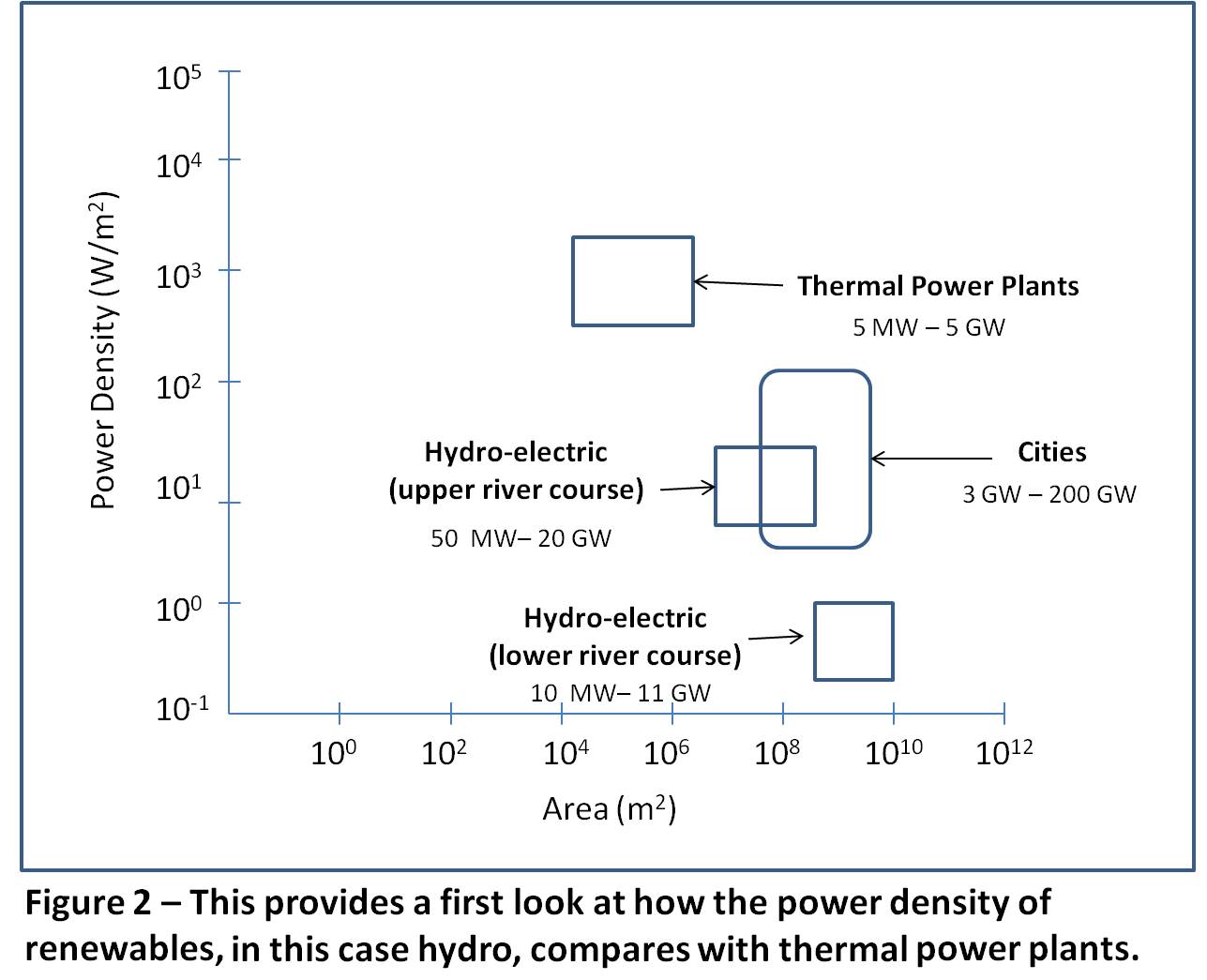
20 GW is shown for hydro, which roughly provides for the Three Gorges Dam in China at 22.5 GW, assuming a high capacity factor. The next largest is the Itaipu Dam in Brazil/Paraguay at 14 GW. All the rest are less than 10 GW. Typical sizes are about the same as the thermal plants.[6]
On an equal power or energy flux basis, this shows that the land area requirements for upper river course hydro-electric plants are about 100 times that for thermal plants, and low power densities for hydro are the reason. The land requirements for lower river course hydro plants are more than 1,000 times greater. Consequently, the land area requirements for hydro do not scale well to handle the volume, peak, reserve, and plant retirement needs.
To illustrate this, in Figure 3 note the extensive land area use requirements for hydro reservoirs compared to all the other components of the world’s electricity systems.
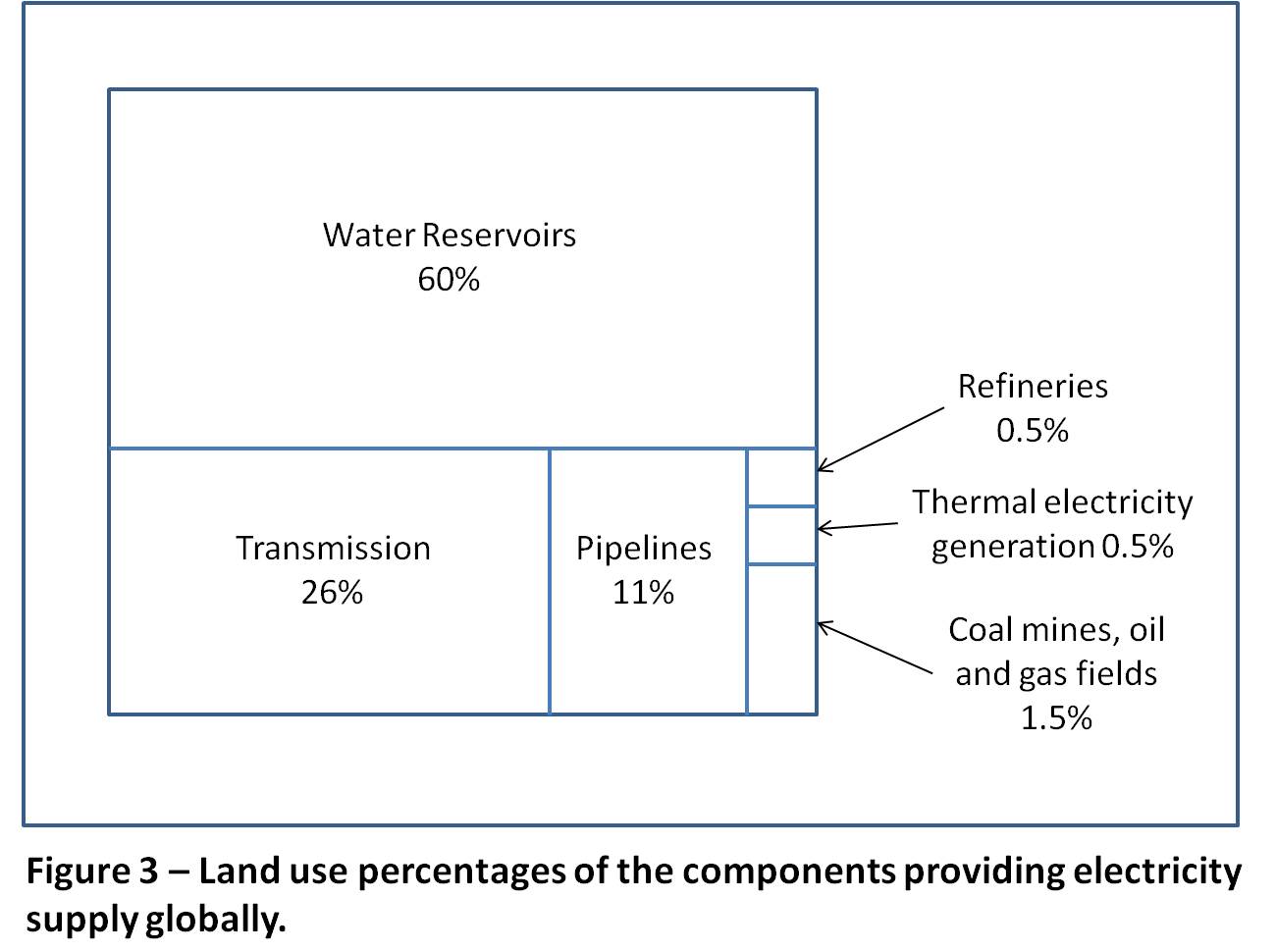
Hydro-generated electricity provides about 16% of global electricity supply,[7] but its land use is 60% of the total.
Hydro has a place today because it is an easily accessible energy source, which also lends itself to storing its energy so that we can use it, generally speaking, as required. It should not come as a surprise that 38 of the top 41 countries that rely on hydro-generated electricity, on a percentage of the total basis, are in Africa, Central and Southeast Asia, and Latin and South America. There are only three developed countries – Norway, New Zealand and Austria, largely due to their topography. In absolute terms, China is by far the leader, at more than double the next largest, the U.S.
Wind and Solar
Figure 4 shows how wind and solar compare. The boxes indicating the ranges of the instances of their generation plants are shown with dashed borders to remind us of the persistently erratic and unreliable behaviour of their electricity supply.
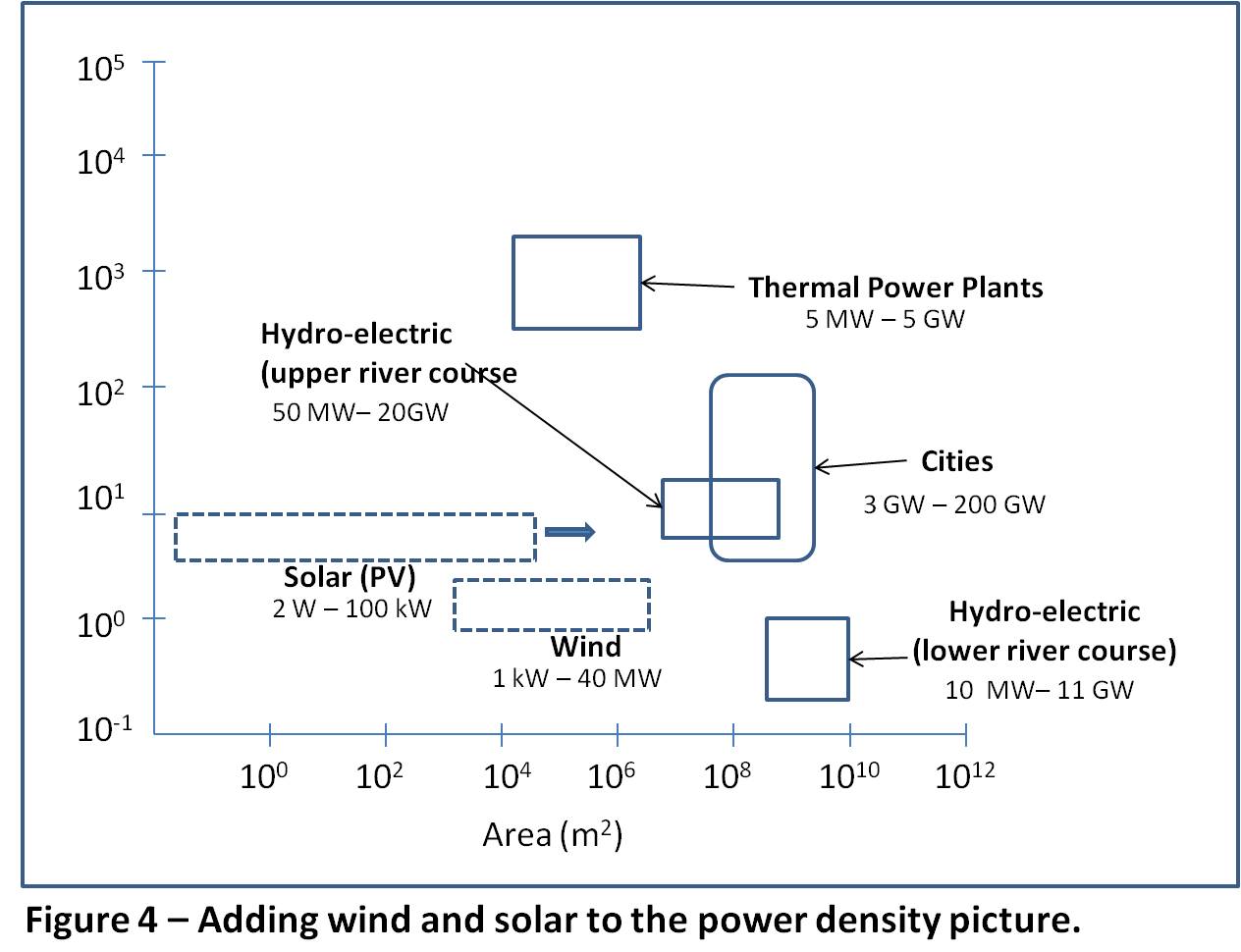
Note the capacities for wind and solar PV do not represent installed capacities, but energy flow levels, expressed in watts based on the low capacity factors dictated by nature itself. The arrow in the solar PV case is intended to show a higher range for solar than Smil does in his diagrams. Larger solar plants exist, including concentrating plants with installed capacities in the hundreds of MW, suggesting an upper range similar to that of wind.
This portrayal provides an appreciation of the realities of employing wind and solar in industrial- or grid-scale applications. Because of low power densities, large land areas are required, and use should be limited to small scale installations in a distributed generation role as this concept is meant to embody. Distributed generation involves the use of the electricity where it is produced primarily for local consumption involving low power density users, and not for feeding the grid to serve distant, high power density users.
Assuming an equal distribution between upper and lower river course hydro plants, solar PV is about the average of the two. So, on an equal energy flux basis, solar PV would require about the same land area as this combination of hydro. If the distribution of upper and lower course hydro is skewed towards the upper course type, and examination of Figure 3 suggests this, then more land would be required for solar PV. As the power density for wind is about one-fifth that of solar PV, the land requirements for wind are about 5 times that of solar PV on basis of equal energy flux, or power.
Because wind and solar PV have low capacity factors, between 15-30%, versus about 50% for a large hydro portfolio, the actual capacities required to deliver the energy flows shown would be at least 2-3 times the hydro capacity.
Remember also that, compared to wind or solar PV, much of hydro capacity is more reliable and not erratic.
Multiple Use of Land
Multiple use of land areas is another factor. For example, hydro reservoirs are also available for recreational purposes. Wind plants are believed to provide extensive other use opportunities of the land area required for them. This does not withstand close scrutiny. Some cultivation might be possible, but little else including human habitation and animal presence, both domesticated and wild. The extensive requirements for unique-to-wind grid additions, especially to collect the dispersed energy source and provide new long distance transmission facilities, access roads for construction and maintenance on the very large wind turbine structures and the negative impacts on rural communities and industrialization of large areas of our natural environments considerations should offset any possible multiple use considerations. Note the large footprint of transmission requirements in Figure 3.
I expect someone will argue that offshore wind avoids the land use problem. There is some current resurgence of the promotion of this by wind turbine manufacturers and their host countries in Europe, which should be seen as an attempt to respond to Chinese competition for international markets in onshore wind turbines. It is extremely unlikely (and arguably impossible) that offshore wind will prevail in our energy portfolios because of power density, energy intensity, costs, short wind turbine life, maintenance and repair limitations as well as ecological concerns.
Additional Power Density Considerations
As can be seen in Figure 3, taking into account the impact of the full fuel cycle would reduce the average power density of thermal plants by a factor of about 5 bringing this down to around twice that for the maximum, and ten times the average of cities. Similar considerations apply to nuclear plants. Taking pipeline land usage into account for gas plants reduces the average power density to almost two times that of the average for cities.
In the case of gas plants and pipelines, the average power density is still three times that of upper course hydro, six times that of solar PV and ten times wind.
It must be remembered that power densities for cities includes all energy needs, not just electrical. However, for future considerations, electricity should be a considerably larger share of this. One conclusion that can be drawn is that fourth generation nuclear (see here and here) and small modular reactor (SMR) plants look promising in the medium to longer term of the period 10-40 years from now. Also, we should not forget the possibility of surprises.
Conclusion
I know it’s all more complicated than represented here, but remember my opening remarks. I said that it may be a bit of an exaggeration to say that understanding power density may be all the average person needs to put our energy sources and needs into perspective, but there is some merit in this argument. I hope the considerations presented here help in bringing more common sense, in all interpretations of this term, to the energy policy discussions.
Winston Churchill said that the inherent vice of capitalism is the unequal distribution of wealth, and the inherent virtue of socialism is the equal sharing of misery. Similarly, current imperatives to impose renewables, especially wind and solar PV, on us through major central planning initiatives, will most likely produce the outcome of reduced energy availability relative to growing needs, resulting in an equal sharing of misery, not prosperity.
In summary, we need extensive amounts of high power density energy resources, especially in electricity systems, to best ensure the continued improvement in human well-being. There is very little room for low power density sources, except possibly in distributed processing environments, which are inherently small-scale.
————————————————–
[1] In general, energetics is concerned with seeking principles that accurately describe the useful and non-useful tendencies of energy flows and storages under transformation. (http://en.wikipedia.org/wiki/Energetics) In other words it describes how we access and use energy.
[2] Smil, Vaclav (2008). Energy in Nature and Society – General Energetics of Complex Systems. The MIT Press. Pages 18-19.
Energy density is also important, but less so. It is measured by volume, in J/m3 (not area), or weight, J/kg. So it is decisive for portable applications or where space and weight are at a premium. Energy concentration (J/m2) reveals the spatial density of resources, a critical measure of extraction or harnessing methods and costs and associated infrastructure needs.
[3] There is another definition, which is the energy flow through the working surface of the energy converter, such as the area swept by a wind turbine, which is more limited in application.
[4] This may be more complicated than portrayed here for the sake of some simplicity. An important distinction must be made between reliable electricity plants, such as fossil fuel and nuclear, versus wind and solar PV plants. The latter are limited at any time by the natural occurrence of the fuel, wind and sunshine, over which the electricity system operator has no control. So in their case, power density, power and energy flux considerations, I take to be based on production over time, which is considerably less than installed capacity. This still ignores the unreliable and erratic nature of such production.
[5] Food is the energy source for our bodies, which we use to maintain body functions, act and think. Thinking takes a remarkable amount of the body’s net energy output. In Voltaire’s words, “Thought depends absolutely on the stomach, but in spite of that, those who have the best stomachs are not the best thinkers.”
[6] A useful list of the world’s power stations is available at http://en.wikipedia.org/wiki/List_of_largest_power_stations_in_the_world
[7] For 2008 http://en.wikipedia.org/wiki/Electricity_generation#Production_by_country
Source: http://www.masterresource.org/2013/02/power-density-wheat-from-chaff/

