Saturday, November 30, 2013

424 Degree CurrentSAFE Find

Example CurrentSAFE Uncovered Hazard

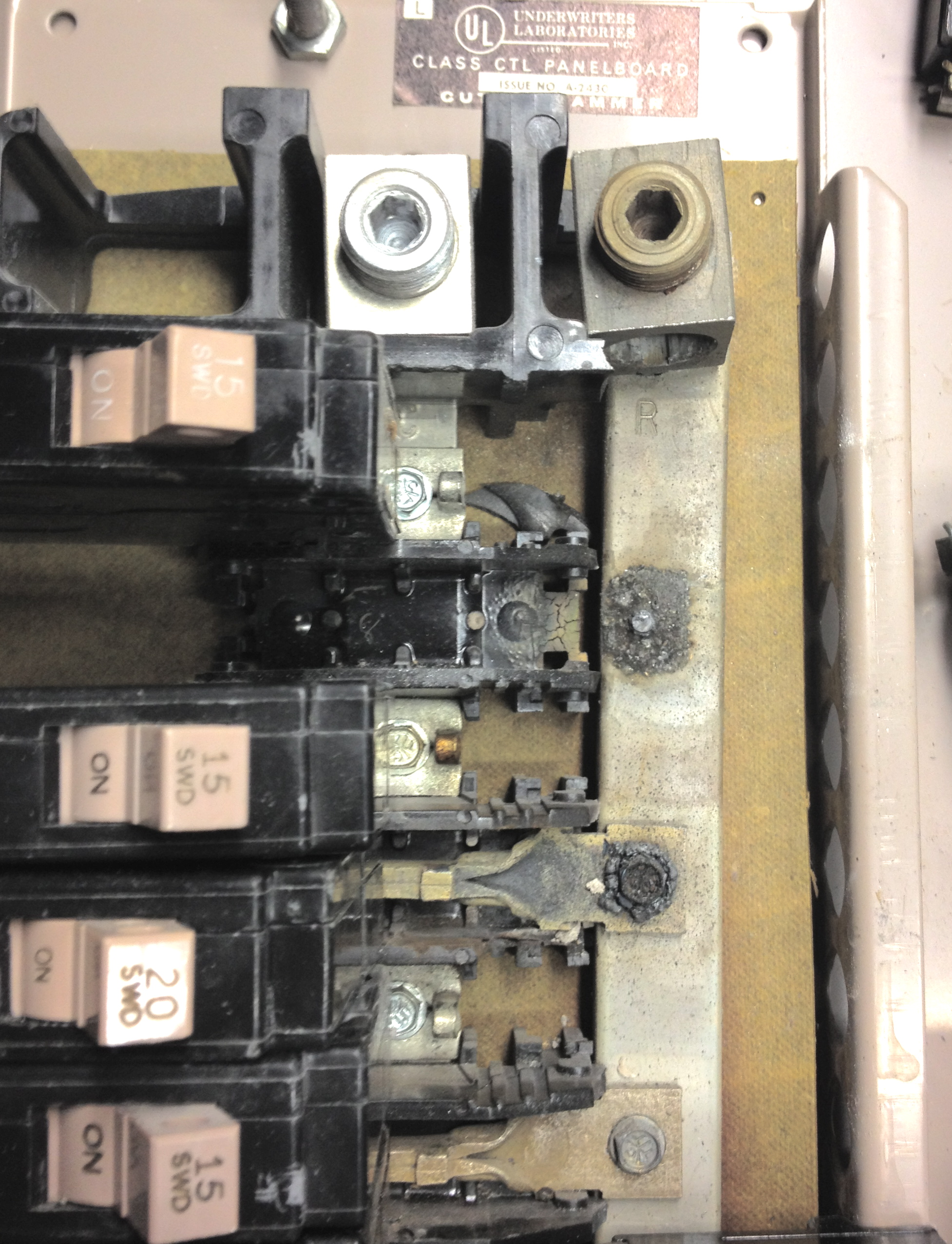
IR 2941 424 Degree CurrentSAFE Find During a CurrentSAFE Electrical Hazard Detection we uncovered a hidden hazard of 424 degrees Fahrenheit on the buss bar of a panel in a home in Montgomery.

Overheated electrical joints due to loose connection are often precursors of electrical fires, arc faults, and arc flash in electrical systems.

Connections that should have had the proper torque, as well as, being properly sized for the amplitude of current would not have overheated to the extent of 424 degrees Fahrenheit.

The issue is that with the fluctuation of current, results in thermal cycling, which eventually leads to the failing of the connection. In other words, the bad connection heats up and cools, heats up and cools, going from one extreme to another under load or no load. With a loose connection that is experiencing overheating, such as in the 424 degree range, this will lead to failure. Meaning either electrical fire, arc fault, or arc flash.

photo 229x300 424 Degree CurrentSAFE Find Here in the digital photo you can see the melted portions of the buss bar and the discoloration of the lug which were a result of the thermal cycling.

Cooper Electric's CurrentSAFE EHD is a preventive maintenance program for your home's electrical system. To learn more and have a free estimate call us at 513-271-5000.

ico tag 424 Degree CurrentSAFE Find Tags:  

Del.icio.us
delicious 424 Degree CurrentSAFE Find
Facebook
facebook icon 424 Degree CurrentSAFE Find
TweetThis
tweet 424 Degree CurrentSAFE Find
Digg
digg 424 Degree CurrentSAFE Find
StumbleUpon
stumble 424 Degree CurrentSAFE Find


Copyright © Cooper Electric [424 Degree CurrentSAFE Find], All Right Reserved. 2013.

Source: http://cooper-electric.net/424-degree-currentsafe-find/

electrical testing commercial electrical electrical commercial electrician contractor contractor electrician

Solar Manifes-two

Due to the increasing number of individuals who have contacted us regarding our pages/posts and those who have chosen to bookmark our website for future reference. We felt it was necessary to add new material to help keep the content fresh and to keep people commenting and sharing which was the original reason we set [...]

Source: http://www.enlighten-electric.com/2012/03/solar-manifes-two/

electrical how to contractor

Space Heater Safety Tips by Santa Monica Electrician

With the winter months closing in, there are some things you need to know before you pull out that portable electric heater. Sure your feet may get cold under your desk or your bathroom is a little cooler than you would like in the morning, but before you plug in that space heater you need […]

The post Space Heater Safety Tips by Santa Monica Electrician appeared first on The Electric Connection.

Source: http://www.theelectricconnection.com/space-heater-safety-tips-santa-monica-electrician/

electrician job electricians jobs electrician work electrical training electrician apprenticeship

What YOU Can Do to Reduce Pollution?

What YOU Can Do to Reduce Pollution?


The U.S. Environmental Protection Agency has prepared this fact sheet to answer some of the most common questions about reducing emissions from private vehicles.


This is an important concern, as cars are a major source of air pollution in the United States. Vehicle emissions contribute to health and environmental problems such as urban smog, air toxics, and global warming. Yet individual driving habits make a big difference in the amount of pollution a car produces.


Three easy things you can do to help keep emissions as low as possible are:


• Avoid unnecessary driving

• Maintain your car properly

• Drive your car wisely


By combining these strategies, you can very effectively reduce the amount your car pollutes. And there are additional benefits — your car will last longer and you will save money.


Avoid Unnecessary Driving

The most effective way to reduce emissions from your vehicle is to use it less.

Vehicle travel in this country is doubling every 20 years. Traffic trends that see

more and more cars driving more and more miles will soon begin to outpace

technological progress in vehicle emission control.


Several options are available to help you reduce the amount you drive. These

include consolidating trips, telecommuting, carpooling, using public transit, and choosing clean transportation alternatives such as biking or walking.

By planning errands, you will get the most out of time you do spend behind the wheel. For example, call ahead to confirm that the product you need is in stock before you drive to the store. Plan to do several tasks when you go somewhere.


Drive to a central location and park. Then walk between nearby destinations.

Ridesharing can be an ideal way to reduce your personal contribution to pollution.


Every time you share a ride and eliminate a trip, you help the environment. Try pairing up for trips to work or to social events — even an occasional carpool or ride on public transportation will make a difference.


Biking or walking to your destination creates no pollution at all. And you’ll

increase your fitness level at the same time.

-
About the Author:
<p>RunGreenPower.com will teach you how to build solar &amp; wind power systems foryour home within a weekend.</p><p>Check It Now: <a rel=”nofollow” onclick=”javascript:_gaq.push(['_trackPageview', '/outgoing/article_exit_link']);” target=”_blank” href=”http://www.rungreenpower.com/2010/09/21/buy-diy-solar-power-kit/”>Why to Buy DIY solar power Kit?</a></p>
Article Source

share save 171 16 What YOU Can Do to Reduce Pollution?

Source: http://reschelectrical.com/what-you-can-do-to-reduce-pollution/

electrical how to contractor

Home Lighting Makeover with Glendale Electrician

Homeowners have a powerful tool at their disposal that they may not even be aware of. Lighting can make or break a room. Having new, updated light fixtures in a room can completely change the way the home looks and feels. And although the actual work is not all that labor intensive, it is crucial […]

The post Home Lighting Makeover with Glendale Electrician appeared first on The Electric Connection.

Source: http://www.theelectricconnection.com/home-lighting-makeover-glendale-electrician/

electrical works electrical repairs find a contractor electrical installations electrical certification

‘Massive’ Fire At NJ Beach Boardwalk Caused By . . .

. . . maybe, by a retail unit that did not pass a post-Sandy electrical inspection, it says here.

That fire destroyed more than 60 businesses, according to the report.

Source: http://electricalcontractor.com/?p=11948

contractor electric electrician job

Check Your GFCI

GFCI receptacles (Ground Fault Circuit Interrupter) are typically found in homes built or remodeled after 1978 and can most often found in the bathroom, garage or exterior outlets. One GFCI may control multiple outlets. It is not uncommon, especially in homes built before 1997, to find the GFCI in the bathroom or garage controlling the […]

Source: http://blog.atselectricinc.com/2012/08/check-your-gfci-10/

able electric auto electrical repair construction electrical electrical how to

Christmas Giving Ideas

Instead of giving money to children this year for Christmas, rethink your gifts to children and consider one of these fine electronic gifts that will have them saying that all-to-technical phrase...cool! Some of the top choices they may enjoy this year can be the gift that keeps on giving. Here are some of my choices.

...

Read Full Post

Source: http://electrical.about.com/b/2013/11/25/christmas-giving-ideas.htm

contracting electrical emergency electrician

Friday, November 29, 2013

How to Beat the Summer Heat

Step outside and it’s not hard to see (and feel) that we’re in the heart of summer.

In Florida, taking a much-needed trip to the beach or pool, stopping by the local ice cream shop and catching an indoor movie are obviously all ways to beat the blazing summer heat. But what can you do to stay cool in your home as the hot air tries to fight its way indoors? Luckily, there are some things you can do to ensure a cooler, more efficient home this summer.

It doesn’t take a rocket scientist to figure out that, as the temperatures rise, it’s likely your electric bill will, as well, but, you don’t have to break the bank this summer! There are a few simple steps that you can take to make sure you’re getting the most of out your air conditioning unit, saving you big chunk of change and ultimately making a huge difference in your electrical spending!

Here are a few steps to take to ensure you, your family and your home stay cool this summer:

  • Don’t use your air conditioner more than necessary. Set timers. When you’re not home, raise the temperature.
  • Don’t cool rooms that aren’t occupied. If you want to have steady airflow in an unoccupied room, try a ceiling fan instead.
  • Keep your air conditioner out of direct sunlight. How? Plant a tree over your exterior unit.
  • Change your air filter once a month during warmer months. This will ensure your unit is working as efficiently as possible.
  • Allow your air conditioning unit to “breath.” Never place furniture or drapes in front of it!
  • When the weather allows, turn off the A/C and open the windows.
  • Reduce in-house heat during the day. Save cooking, bathing, laundry and dish washing for later in the evening, when the sun isn’t creating heat in your home.
  • Keep your house closed tight during the day. This will keep any unwanted heat or humidity from getting inside your home, which could potentially counteract all of the hard work your air conditioner is doing.

Keep in mind: Winter is just a few months away! In the meantime, if you have any questions, feel free to contact us.

Source: http://powergenerationinc.com/how-to-beat-the-summer-heat/

electrical maintenance electrician certification electrical contracting contracting electrical emergency electrician

Light switch mysteries solved!

Got a mystery switch? This can be a good thing, presenting an opportunity to add control of stair/hallway lighting from both ends of the hall or stairwell, or the ability to switch a receptacle outlet (or bypass a switch to eliminate mystery outages at the outlet).

A properly wired 3way or multi-way switch coordinates with other switches to control a light fixture or lighting zone (group of fixtures or recessed lights), or any other switched load.

In Philadelphia shotgun row houses, first floor 3way switches are often mis-wired to have no function (on the first floor) and only compromised function on a remote stair landing or other location closest to the lighting fixture. Using only the proper switch component and an understanding of multi-way switch wiring systems, we can often restore the original, coordinated multi-location switching configuration to control 2nd floor lighting (or other locations remote from your mystery switch) so that you can turn it on (or off before leaving the house) without climbing stairs or traversing rooms in darkness.

How can I tell if my switch is a coordinating type switch (part of a multi-way switch system)?

Simple single-location, standard ‘toggle’ style light switches have ‘on’ and ‘off’ embossed at the visible fulcrum of the lever, whereas switches designed to participate in a multi-way switching system may be ‘on’ or ‘off’ in either position, depending on the position of other switches in the system. Therefore, 3way and 4way switches have no ‘on’ or ‘off’ designation. So if your mystery switch is of the latter sort, you may have a miswired multi-way switching system. If your switch does have on/off embossing, it may be properly wired to control a lighting fixture or plug-in receptacle load (for floor lamps) from only one location, OR, it could be that an unskilled installer updated switch and receptacle devices in the home but ignored, lost track of, or abandoned a coordinating switch wiring system, turning a very useful switch location into a cloying mystery.

Multi-way switch systems often suffer from a mis-wired location that disables the other switches when that bad switch is thrown to the up or down position. 90% of the time, the original wiring is good but someone installed a wrong switch or installed the right switch incorrectly. Occasionally, the wiring system itself is deficient and the only fix is new cable runs between switch locations and/or the switched light fixture.

Licensed Electrician Robert Monk Light switch mysteries solved! Copyright Robert Monk, 2012

Source: http://www.phillylicensedelectrician.com/light-switch-mysteries-solved/

electrician jobs electrical installation

Lighting 101: Compact Fluorescent Bulbs (CFLs)

When looking into lowering your electricity costs, a popular option is to switch all of the light bulbs in your home or office to compact fluorescent light (CFL) bulbs. Switching to CFLs couldn’t be easier, but it’s not uncommon to wonder: are these bulbs really more efficient than regular incandescent bulbs?

The answer is simple: yes!

Here are some facts about CFLs, according to ENERGY STAR:

  • They use 75% less energy than standard bulbs.
  • They can last for more than 3,000! Compare that to the average 1,000 hours for a standard light bulb.
  • They can create less than 75% less heat than regular bulbs. This means, when you keep your lights on for a long period of time, your house won’t heat up!
  • They can help lower your overall electricity usage and utilities.

The Science Behind CFLs

Creating light by running electricity through a resistive filament, incandescent light bulbs heat the filament to a very high temperature. This causes the bulb to glow and produce an extremely visible light, however more than 98 percent of the energy used is emitted as heat.

On the other hand, CFL bulbs produce ultraviolet light, working by passing electricity through a mercury vapor, exciting the gas. As the UV light hits the white coating inside of the CFL bulb, the coating changes into a light that you can see. CFL bulbs don’t use heat to create light.

Lumens Per Watt

A regular incandescent bulb can produce about 15 lumens per watt while CFL bulbs typically produce 50 to 70 lumens per watt. In other words, you can buy a 15-watt CFL bulb that produces the same about of light as a regular 60-watt regular incandescent bulb.

Incandescent       CFL
40w

=

   10w
60w

=

   13w-15w
75w

=

   20w
100w

=

   26w-29w
150w

=

   38w-42w
250w-300w

=

   55w

General Cost and Lifespan

A 6-pack of GE 60-watt incandescent light bulbs costs approximately $4 while a 2-pack of GE 15-watt CFL bulbs (equivalent to a 60-watt regular incandescent bulb) costs approximately $13. While it’s clearly obvious that regular incandescent bulbs are inexpensive, the typical lifespan is around 1,000 hours versus an average lifespan ranging between 1,200 to 20,000 hours for CFL bulbs.

Savings

Using 2/3 less energy than a regular incandescent light bulb and lasting up to 10 times as longer, replacing your average 60-watt regular incandescent bulb with a 15-watt CFL can save you at least $30 in energy costs over the lifespan of the bulb. On average, you’ll save approximately $6 per year per bulb.

Questions? Feel free to contact us!

Source: http://powergenerationinc.com/lighting-101-compact-fluorescent-bulbs-cfls/

electrical contracting contracting electrical emergency electrician licensed electrician electrical supply company

A Guide To Choosing Ceiling Lights For Your Bathroom

Have you ever heard the saying ‘a change is as good as a holiday’? There is plenty of truth to this statement; take, for example, changing the ceiling lights in your bathroom – this small act alone could make it feel like a whole new space. There is more to this decision, however, than just walking into a showroom, pointing at a fixture you like and saying ‘that one’. Use this guide to ensure that you are making the right choices for your bathroom in regards to San Gabriel Valley lighting.

Our bathrooms need to be functional above everything else, and the ceiling lights that you ultimately choose for your space will help to determine with this is the case. There is no point in installing a fixture that looks stunning if it prevents you from completing all of the tasks that you would normally undertake in the space, such as shaving and applying make up. This is not to say, however, that homeowners should forget about the aesthetics of their lighting fixtures – instead, it is about finding a balance.

One way to achieve this is by choosing ceiling fixtures that you can easily adjust in both direction and levels of illumination.

  • Illumination: the best way to control the level of illumination in your bathroom is by installing dimmer switchers in conjunction with your ceiling lights. You could also opt for the traditional fixture that includes both heat and normal lights. Whilst this only gives you the choice of two levels of brightness, it may be sufficient for your needs.
  • Direction: the best way to control the direction of lighting in your bathroom is by installing ceiling lights that are mounted into moveable supports. Halogen and LED lights are often mounted in this way, and their fixtures allow you to point the lights in the direction that you need the most illumination (such as over the vanity or the shower stall).


Thankfully, there is plenty of aesthetically pleasing ceiling lights out there that also achieves adequate illumination that can be dimmed or brightened and directed to a certain area. Recessed lights and downlights sit flush with the ceiling and appear as if they’re not even there during the day, whilst a chandelier will make a luxurious and elegant statement. If going for a ‘wow-factor’ fixture, such as a pendant or chandelier, it is recommended that you do the rest of your bathroom as minimalist as possible to avoid overpowering the space.


Source: http://www.accurateelectricalservices.com/CA-Electrician/lighting/guide-choosing-ceiling-lights-bathroom

contractor contractors

Electrical Components Compromised By Flood Waters

Seaside Heights, N.J. - Officials determined that the electrical fire which claimed 50 businesses in the Jersey Shore communities, was caused by electrical components. Investigators said the fire began under a building due to failed electrical equipment. "During the storm, this wiring and these connection became fully submerged in water," Ocean Country Prosecutor Joseph Coronato said in a news conference. "Over time, degradation of this wiring and these connections occurred." They urged that homeowners and other businesses affected by water to have their wiring inspected for similar issues.

 Electrical Components Compromised By Flood Waters

Here in Cincinnati, similar instances can happen with flooded basesments, or homes that have water leaks in upper floors that trickle down to lower levels, causing damage to wiring inside the walls. After a flood in the home or a business, even minor leaks or toilet over flows, a CurrentSAFE test of your electrical system can prevent electrical failures caused by components that are compromised during a flood. Degradation of electrical materials that are negatively effected by exposure to water are hazards. These types of things can be found and eliminated with the CurrentSAFE process.

Disaster Recovery is key, and our CurrentSAFE professionals understand the importance of returning the home and electrical system to the specific state your house was in before disaster occurred. We are knowledgeable in helping consult you on the processes that follow these types of unfortunate events.


ico tag Electrical Components Compromised By Flood Waters Tags:  

Del.icio.us
delicious Electrical Components Compromised By Flood Waters
Facebook
facebook icon Electrical Components Compromised By Flood Waters
TweetThis
tweet Electrical Components Compromised By Flood Waters
Digg
digg Electrical Components Compromised By Flood Waters
StumbleUpon
stumble Electrical Components Compromised By Flood Waters


Copyright © Cooper Electric [Electrical Components Compromised By Flood Waters], All Right Reserved. 2013.

Source: http://cooper-electric.net/electrical-components-compromised-by-flood-waters/

electrical work electrical job electrical tools electric work electrical services

Bathroom Wiring

Every home has a bathroom or two and they need electrical circuits to run them, but how many? One might think that one circuit should surely be able to handle such a small room, but you would certainly be wrong! In fact, there are more circuits needed in many bathrooms in places you may not have thought of.

...

Read Full Post

Source: http://electrical.about.com/b/2013/11/11/bathroom-wiring.htm

a electrical contractors contractors electrical

Modernize from clunky mechanical timer to auto adjusting digital multi-day lighting timer

Did your lighting timer go out of whack with daylight savings time? Tired of fussing with resetting awkward, over-sized mechanical timers that keep time about as well as granddads wind-up watch from Kmart? New digital timers operate reliably for two years or more on battery, keeping time according to astronomically calibrated daylight tables, and removing the need for twice-per-year timer adjustment, and increasing your options for lighting and other timed-load programs.

Contact Robert Monk Electric to arrange installation of a replacement or new timer switch for flood lights around your home or business, or common area lighting in multi-unit rental properties. Installed cost may range from $200 to $500, depending on the type and layout of existing wiring.

A digital timer with GFCI receptacle takes up less room and offers many more features than the bulky, clumsy mechanical timer it replaced.

A digital timer with GFCI receptacle takes up less room and offers many more features than the bulky, clumsy mechanical timer it replaced.

Mechanical timers can open and close loads in excess of 2000W -- possibly their only advantage.

Mechanical timers can open and close loads in excess of 2000W — possibly their only advantage.

Licensed Electrician Robert Monk Modernize from clunky mechanical timer to auto adjusting digital multi-day lighting timer Copyright Robert Monk, 2012

Source: http://www.phillylicensedelectrician.com/modernize-from-clunky-mechanical-timer-to-auto-adjusting-digital-multi-day-lighting-timer/

industrial electrical electrician training master electrician electrical business electrical technician

Mancave Credit

We recently did work on a man cave project with Tony Siragusa.

todd resch man cave1 Mancave Credit

share save 171 16 Mancave Credit

Source: http://reschelectrical.com/mancave-credit/

a electrical contractors contractors electrical

Thursday, November 28, 2013

FPE Panels and Zinsco Electrical Panels Could Catch on Fire – Electrical Service Change

Bob Frank, owner of Perfect Electric and Air, discusses in this video the need to have an electrical service change due to the hazards and dangers of having FPE electrical panel, Zinsko electrical panel or Fuse electrical boxes installed in your house. Another important factor that Bob is bringing up is that Citizens Insurance does not [...]

Source: http://www.perfectelectricrepairs.com/2013/fpe-panels-and-zinsco-electrical-panels-could-catch-on-fire-electrical-service-change.html?utm_source=rss&utm_medium=rss&utm_campaign=fpe-panels-and-zinsco-electrical-panels-could-catch-on-fire-electrical-service-change

contractor electric electrician job electricians jobs electrician work electrical training

How do I know if I have FPE panel or Zinsco panel? Electrician Fort Lauderdale

Bob Frank, owner of Perfect Electric and Air Services located in Fort Lauderdale area, explains in this video how to identify FPE panel and Zinsco electrical panel. There are many potential hazards with these types of panels, including potential fires, and because of it homeowner’s insurance companies are not longer willing to insure homes with FPE and [...]

Source: http://www.perfectelectricrepairs.com/2013/how-do-i-know-if-i-have-fpe-panel-or-zinsco-panel-electrician-fort-lauderdale.html?utm_source=rss&utm_medium=rss&utm_campaign=how-do-i-know-if-i-have-fpe-panel-or-zinsco-panel-electrician-fort-lauderdale

electrical commercial electrician contractor

The End of Incandescent Light Bulbs

There have been many articles in electrical trade magazines lately that have discussed the future inevitable ban of the old standard incandescent light bulb. California usually leads the nation in energy conservation trends and discussions there are leaning towards an all out ban by 2012. Many of you are probably using fluorescent replacement lamps in […]

Source: http://blog.atselectricinc.com/2012/08/the-end-of-incandescent-light-bulbs-8/

electrical tools electric work electrical services electrical parts home contractors

New homeowner? Receiving Home Depot coupons? Trade for electrical services!

If you have 10% or 20% off coupons from Lowe’s or Home Depot, consider sending us shopping for you with the coupon. We’ll pick up a few supplies for ourselves at discount, and may be able to work out discounted repairs or installation for you in trade.

Licensed Electrician Robert Monk New homeowner? Receiving Home Depot coupons? Trade for electrical services! Copyright Robert Monk, 2012

Source: http://www.phillylicensedelectrician.com/new-homeowner-receiving-home-depot-coupons-trade-for-electrical-services/

service electrical electrical jobs

Let Your Little Christmas Lights Shine!

This time of year is definitely the time to decorate the tree with garland and Christmas lights. The glow of colored lights glistening throughout the house while waiting on old St. Nick. But what happens when the lights suddenly go out? Is Rudolf stealing the power to light his nose? Is there a power outage? Well don't get too excited yet. Let's examine what some of the probable causes are and how to remedy the problems. Do you know how to keep your Christmas lights shining?

...

Read Full Post

Source: http://electrical.about.com/b/2013/11/25/let-your-little-christmas-lights-shine.htm

electrical construction electrical works electrical repairs find a contractor electrical installations

What Solar Panels Cost

If you’re thinking of installing solar panels for your home, you’re probably doing a lot of research to see what the costs and your options are. There is a lot to get up to speed on, so let’s start with what solar panels cost. Solar panels have been steadily dropping in price, due to more […]

The post What Solar Panels Cost appeared first on The Electric Connection.

Source: http://www.theelectricconnection.com/solar-panels-cost-2/

electrician training master electrician

Tips: Hiring the right electrician.

How do you know your hiring the right electrician?

Source: http://www.blueskyelectric.net/blog/tips-hiring-the-right-electrician/

electrical contractor in what is an electrical contractor electrical service service electrical electrical jobs

Claremont Electric Floor Heating Systems

Claremont electric floor heat systems are used to warm up the entire floor in your living room or office room with electric mechanisms. With these heating systems, you can enjoy the comfort of warm floors even in bone chilling winter season when there is snow all around.

Most of these electric floor-heating systems provide soothing comfort and consistent even heat for your Claremont floor. The floor can be of any type or shape, such as tile, stone, laminate, and engineered wood floors without cold spots. Most of these heating systems are easy to install, energy efficient, and can be controlled using a variety of programmable and non-programmable thermostat options.

Radiant floor heating has improved drastically when it comes to efficiency and working mechanism along with other safety and user-friendly features.   The floor radiates heat to your feet, warming you all over. Most familiar are hydronic systems that heat your entire house.  A simpler, less expensive alternative for just a single room is electric floor heat systems. They are easy to install and inspect. Due to their simple mechanism, you can install it in your Claremont home with far less trouble and expense than you might expect.

Claremont electric floor heat systems consists of thin heating cables, like the wires in an electric blanket, installed under ceramic tile. It is because of these thin wires that they do not raise the level of the flooring unnecessarily much. That results in a great option for remodeling.

Most of these electric radiant systems can be installed easily where warm floors are appreciated, including bathrooms, mudrooms, and kitchens. As their own thermostat controls them, so they do not replace your main heating unit rather they augment it.

Similarly, other part of any popular electric floor heating system is an insulation board, which will save your hard-earned money when used in conjunction with radiant floor heating by acting as a very efficient thermal barrier. They reflect the radiant heat upwards instead of allowing the heat to be absorbed by the concrete. That results in a lot of time, energy and money.

Other important parts are thermostats, which are being used in almost every heating mechanism or method. These fully programmable thermostats save you heating costs by turning your heaters on only when you need a heated floor. Actually, an electric radiant heat sensor fitted under the tiles controls your Claremont radiant heating.

Source: http://www.accurateelectricalservices.com/CA-Electrician/floor-heating/claremont-electric-floor-heating-systems

contractor electric electrician job

Wednesday, November 27, 2013

The End of Incandescent Light Bulbs

There have been many articles in electrical trade magazines lately that have discussed the future inevitable ban of the old standard incandescent light bulb. California usually leads the nation in energy conservation trends and discussions there are leaning towards an all out ban by 2012. Many of you are probably using fluorescent replacement lamps in […]

Source: http://blog.atselectricinc.com/2012/08/the-end-of-incandescent-light-bulbs-8/

electrical jobs a electrical contractors contractors electrical electrical contractors in electrical contractors

5 Energy Savings Myths Debunked

Nowadays, it seems as though everyone wants to save money while saving energy. Whether you do it for your wallet or the planet, taking extra steps to go green definitely has its benefits. But there’s so much information out there, it’s hard to know what’s actually true!

Myth #1: Closing your A/C vents saves energy.

Since energy is consumed by the air unit itself, closing your vents will not help with your use! When you close the vents in one room, it restricts the air at that specific vent, redirecting the air to other locations and through possible leaks in the duct system. Closing vents can also put pressure on the fan that pushes the air through the system, ultimately causing the system to work harder.

Myth #2: Leaving a ceiling fan on will cool a room—even if no one is in it.

Fans cool people, not rooms! Ceiling fans circulate the air in the room to create a draft, making you feel cooler—they don’t actually lower the temperature in the room. Leaving your ceiling fan on when you’re not in the room is a waste of both energy and money. To start saving, make sure you turn fans off before leaving a room.

Myth #3: Setting the thermostat higher heats your home faster.

Although setting your thermostat higher does have the potential to increase the run-time of the heating system, doing so will also cause the system to use more energy. Not to mention, your home can become uncomfortably hot extremely fast. Setting the heat to an appropriate temperature will get the job done—just be patient!

Myth #4: Leaving a light on uses less energy than turning it off, then on again.

As ridiculous as it may sound, some people do believe that leaving a light on for an extended period of time—rather than turning it off and on again—uses less energy. Despite the on again/off again effect, there is actually no significant additional power drawn when turning on a light bulb. Lights should always be turned off each time you leave a room, even if it’s just for a few minutes. There’s no reason for a light to be on in a room with no one in it. It’s wasteful and will heat up the room, potentially making your A/C work harder.

Myth #5: Leaving your air conditioning running when you’re not at home is more efficient than having to re-cool a space once you return.

Although this is false, you should never turn the system off completely. In doing so, more energy will be used to cool down your entire house as your air conditioning unit tries to replace the warm air that’s accumulated throughout the day. At the same time, however, it’s inefficient to leave your air conditioning unit on all day. This will cause the compressor to operate regularly for the hours you’re not at home. Ideally, you’ll want to lower your system when you leave the house for extended periods of time and set a timer for about a half hour before you return home.

Source: http://powergenerationinc.com/5-energy-use-myths-debunked/

electrician work electrical training

Avian Mortality: Union of Concerned Scientists’ Negin Debunked in Real Time

 “I have no idea who Jim Wiegand is, but the Master Resource website is highly questionable….”

“Jim: My apologies. I was overreacting…. Perhaps you would be better served if you avoided that [MasterResource] crowd.”

So said Elliott Negin, Director of News & Commentary at the Union of Concerned Scientists, several days ago in the comments section of his Huffington Post  piece, Wind Energy Threat to Birds Is Overblown.”

Mr. Negin is a serial user of the argumentum ad hominem. The Free Dictionary defines ad hominem as: “Appealing to personal considerations rather than to logic or reason: Debaters should avoid ad hominem arguments that question their opponents’ motives.”

In his piece, Negin takes on journalist and scholar Robert Bryce, whose exposés of politically correct renewable energy have clearly stuck a nerve with mainstream environmentalists whose embrace of industrial windpower is problematic.

Negin’s statements such as “Bryce … likely will continue to attack renewable energy at every opportunity on behalf of his benefactors” are a low blow indeed. Perhaps Negin would like to square off with Bryce in a public debate with media present to see who the real environmentalist is and who has the better facts and arguments.

My money is on Bryce, and not because he is necessarily an effective debater. He is. It is just that wind power is ecologically suspect beyond a best-of-evils forgiveness.

Bad Timing!

But just hours after Negin’s post went live, Kate Sheppard of the Huffington Post reported some big news: Duke Energy Renewables Guilty Plea Nets Big Fine for Bird-Killing Wind Turbines. “The company admitted killing 14 golden eagles and 149 other protected birds, including hawks, blackbirds, larks, wrens and sparrows, at two sites in Converse County, Wyo., from 2009 to 2013,” Sheppard wrote.

“Wind energy is not green if it is killing hundreds of thousands of birds,” the American Bird Conservancy replied to the verdict (as reported by Sheppard). “The unfortunate reality is that the flagrant violations of the law seen in this case are widespread.”

Negin quickly added an update to his post with the development.

Here Come the Comments

A number of readers were not sympathetic to Negin, one noting how rated-design capacity of windpower was hardly indicative of what it can produce given its  low capacity factors. This simple, well-known fact is routinely ignored by the American Wind Energy Association—and non-critical (crony) environmentalists.

Enter Jim Wiegand, of MasterResource import, who pushed back on Negin’s attacks on Robert Bryce with his comment:

Robert Bryce is not a wildlife biologist. But I am, and his article grossly understated the industry’s  hidden bird and bat genocide.

The wind industry is set up to hide their horrific mortality problem. Some East Coast studies I have looked have concealed tens of thousand of fatalities. I recently looked over a 7 month study that I believe concealed over 25,000 bat fatalities and over 5000 bird fatalities. This was the estimated mortality from just 28- 2.5 MW turbines after making adjustments for their tiny search areas and other factors.

The study reported finding 262 bird carcasses and 706 bat carcasses. Searches for carcasses amounted to about 56% of a 50 distance from towers. These turbines had blades 50 meters in length and searches should have been 200 meters. These turbines are also located in the known habitat of the endangered Indiana bat.

How many of the unreported 25,000 bats were of this species? We will never know. From several different sources. I now have carcass distance data from hundreds of wind turbine fatalities that shows at least 90% of carcasses are launched and land beyond blade lengths. A turbine with 50 meter blades (2MW-2.5MW class turbines) should have search areas of 200 meters from towers for all these carcasses.

The “study” reported a mortality rate of just 6.4 birds/MW and 15.61 bats/MW. The public should be outraged by this because the industry is concealing millions of bird and bat fatalities each year with their bogus research.

Negin replies:

The studies I cite in my blog are not industry studies. They were conducted by scientists and most of them were published in peer-reviewed journals. In any case, all energy technologies have drawbacks.

Nuclear and coal plants kill millions of fish annually, for example. And birds crash into their cooling towers, although I have not been able to find any studies estimating the numbers. Then there’s the threat of climate change to migratory birds. No energy technology is completely benign.

Wiegand comments:

The wind industry has been hiding behind fraudulent studies and mortality monitoring for several decades. “Voluntary regulations” have created an environment with mortality impacts not being reported, or not being properly studied. When mortality is studied the wind industry methodology is rigged with search areas 10-25 times too small, improper search intervals, and many other tricks. None of this is scientific.

Also hidden has been the fact that these turbines are such prolific killers that in years to come these turbines will be the reason for the extinction of many species.

The blade strike slaughter applies to everything that flies that must share the same habitat with these turbines. This includes bees and other insects as well. For birds and bats the mortality footprint of every single turbine reaches out thousands of miles because of the migration patterns for these species.

My research into the wind industry indicates that the wind industry hides over 90% of their mortality with “their” studies.

Negin then went ad hominem in spades:

I have no idea who Jim Wiegand is, but the Master Resource website is highly questionable. The top “principal” listed on the site is Robert Bradley Jr., the founder and CEO of the Institute for Energy Research (IRE), a fossil fuel-industry front.

Over the last decade or so, IER and its political arm, the American Energy Alliance, have received hundreds of thousands of dollars from ExxonMobil; the American Petroleum Institute, the oil and gas industry’s trade association; the Center to Protect Patient Rights, a secretive nonprofit group linked to Charles Koch and his brother David, the billionaire owners of the coal, oil and gas behemoth Koch Industries; and the Charles Koch-controlled Claude R. Lambe Charitable Foundation, one of a handful of Koch family funds. (For more info, see here.)

Another principal on the list is Marlo Lewis from the Competitive Enterprise Institute, which until recently was one of the most-cited climate change denier organizations. Over the years CEI also has received significant funding from ExxonMobil and the Koch brothers’ foundations. For more on CEI, see here).

I wouldn’t trust anything Mr. Wiegand has to say.

Wiegand responded:

Mr Elliott [Negin] stated below “I wouldn’t trust anything Mr. Wiegand has to say”.

What Mr. Elliott failed to point out is that I have posted articles and scientific facts about wind turbine mortality all over the world. Why did he not attack everyone? The Master Resource site is just one of many.

I encourage readers to search the internet for all this information and remember no one pays me. I work for Nobody. I am only trying educate the public so protected species can be saved from this terrible industry.

If another industry in some way benefits from my research I can not help that. Maybe it is as simple as other industries and people caring about eagles. All I really care about is that the wind industry stops slaughtering off our precious wildlife, especially eagles. I have studied eagles for decades.

As for the news below about Duke Energy being prosecuted, I believe dozens of wind projects could be prosecuted for rigging mortality studies and hiding the deaths to rare and endangered species.

Negin then backtracked:

Jim: My apologies. I was overreacting to the fact that you published your story on a site run by Koch- and ExxonMobil-funded climate science contrarians, which I immediately found suspect. Perhaps you would be better served if you avoided that crowd.

In any case, I appreciate your passion for protecting birds. But what I have to go on is the peer-reviewed literature — which you apparently dismiss. It shows that the number of birds killed by other manmade sources dwarfs the number attributed to the wind industry. That is not to excuse the wind industry, mind you. But I wanted to put this problem in context, which was sorely missing from Robert Bryce’s columns.

Have you published peer-reviewed studies yourself that contradict the conclusions of the some of the studies I cite? If so, please post the links.

As for Duke prosecution, as I mention in my blog, Fish and Wildlife was investigating 18 turbine-related bird death cases and referred seven of them to the Justice Department. I assume the Duke case was one of those six. When I get a moment I will post an addendum to my blog mentioning the Duke settlement.

To which I can now respond to Negin:

  • I was attacking the economically unjustifiable, ecologically damaging wind power industry back at Enron (see here);
  • There is a strong moral case for the most abundant, affordable, and reliable energies;
  • Dense, reliable energies are better for the environmental than dilute, intermittent energies (wind and solar);
  • Marlo Lewis, the present writer, and others that I know on the free-market side of the energy sustainability debate are not bought-and-paid-for, as Negin asserts.

Getting back to ad hominem argumentation, I stated elsewhere:

the basic thing about free marketeers is that we have arrived at what we feel is the intellectually correct, moral, utilitarian position–and then we seek funding. We do not just sit back and decide to go with the highest bidder.

Richard Belzer added:

there is a serious simultaneity bias. One cannot easily tell if funding influenced the research or research influenced the funding. One’s first priority should be addressing the merits. If and only if an argument fails on the merits should one delve into whether funding might explain why.

The reason is that all funders have agendas, including (and often especially) the government. There are many competitive government-funded research programs for which compatibility with the agency’s agenda is a transparent criterion for funding eligibility.

For some reason, those who object to “industry” funding seem not to object to this. I find this especially ironic given that the prevailing view among free-market types is that “industry” is intensely non-ideological because profit is neither Blue nor Red. Because profit is as easily located in productive activity as in rent-seeking, it is a rare policy issue in which “industry” cannot be found on both (all?) sides.

Mr. Negin, the ball is in your court. I leave you with this quotation that gets to the heart of the matter:

Truth is what gets results…. Continual questioning and brainstorming … is what we call a challenge process.

The quality of this process depends on a willingness to respectfully engage in open, honest, and objective debate, to challenge the status quo, and to consider humbly any challenges to our own beliefs, proposals, and actions. This applies just as much to challengers as to those being challenged….

“As the philosopher, economist, and Anglican bishop Richard Whately observed: ‘It is one thing to wish to have truth on our side, and another thing to wish sincerely to be on the side of truth.’”

This quotation comes from page 115 of Charles Koch’s The Science of Success (Wiley & Sons, 2007: reviewed here). If you dare read this book from your declared dreaded enemy, Mr. Negin, you might just start a long, agonizing process of self-questioning that just might make you less of a climate alarmist, statist, and “PR hack”—and more of a scholar and free-market, pro-consumer, pro-taxpayer advocate.

Source: http://www.masterresource.org/2013/11/avian-mortality-negin-vs-wiegand/

electrical engineer electrical wiring electrical company electrical supplies electric repair
Landscape Lighting

Low voltage landscape lighting is an easy and cost effective way of providing dramatic lighting effects in your outdoor spaces and significantly enhance the beauty of your home. These systems have come a long way from the original tiered “pagoda” fixtures, with many styles, materials and power options to choose from. Fixtures with photovoltaic cells […]

Source: http://blog.atselectricinc.com/2012/08/landscape-lighting-9/

contractors electric electric contractors

Home Inspection Electrical Repairs

I remember the first call I received many years ago from a client that was panicked over a home inspector’s report that said she needed to re-wire her entire house that she was selling. Her older home was built before ground wires were required in the electrical cabling. Home inspections are a valuable part of […]

Source: http://blog.atselectricinc.com/2013/02/home-inspection-electrical-repairs-10/

electrical contractors company certified electrician construction electrician able electric auto electrical repair

How Long To Grow Tomatoes – Juicy Delicious Tomatoes

Ketchup is just one by product that you can get from tomatoes. And the fresher it gets better it is. To give you freshly picked tomatoes, you might want to learn how to start growing them. But instead of just learning how long to grow tomatoes, it is ideal to learn the essentials on how to care for them as well. There are only a few rules to follow so better start learning them for you to reap the rewards of fresh harvest in no time.

Click Here For Juicy Delicious Tomatoes Instant Access Now!

As have said earlier, there are only a few basic steps in trying to grow your own tomatoes. And depending on how well you take each aspect in consideration, it will pretty much determine how long to grow tomatoes. You can always ask your neighbors if you seem to lack such information or you can find yourself a guide that you can now find online these days.

One of the things you might want to have in order to produce the best tomatoes is the proper lighting. As a matter of fact, the more you expose your crops to sunlight, the better they are going to get. However, make sure not to place them in a place where wind is abundant.

Another thing to consider is the soil you are planning to plant your tomatoes in. The best thing to do is to sterilize your soil from time to time. It is recommended to do so twice every season. What is important is that your soil is free from various infections or diseases that could affect your plants.

It is also important to keep your soil moist at most times. These are just some of the things to consider. Why learn how long to grow tomatoes if you could only learn the best ways to care for them instead. Doing so will surely get you there – an unlimited supply of fresh tomatoes.

Click Here For Juicy Delicious Tomatoes Instant Access Now!

-
About the Author:
This author writes about Tomato Planting Tips at Juicy Delicious Tomatoes
Article Source

share save 171 16 How Long To Grow Tomatoes   Juicy Delicious Tomatoes

Source: http://reschelectrical.com/how-long-to-grow-tomatoes-juicy-delicious-tomatoes/

electrical services electrical parts

How To Do Math

Here’s a forecast from Navigant Research:

. . . worldwide sales of light duty hybrid and plug-in electric vehicles will reach 6.6 million units annually in 2020, representing almost 7 percent of the total light duty vehicle market.

NOTES

a. It’s a forecast, not a sure thing.

b. The math is important. Navigant claims that, IN THE YEAR 2020, hybrids and plug-ins, together, will comprise “almost” 7% of the number of light-duty vehicles sold on Planet Earth.

But does that mean that 6-point-something-percent of the vehicles operational on the planet in that year will be EVs of some sort? NO!!!

It just is a percentage of sales. At the end of 2020, those cars sold will be in operation — as will many, many, MANY cars sold this year, and last year, and in all of the years between now and 2020.

SO ANOTHER WAY TO ANALYZE THE NAVIGANT SENTENCE IS: By 2020, the hybrid/plug-in EVs being driven around on Planet Earth will be the proverbial Drop In The Freaking Bucket.

Source: http://electricalcontractor.com/?p=11946

electrical wiring electrical company electrical supplies electric repair contractor electrical

When Lightning Strikes Be CurrentSAFE

CurrentSAFE House 300x235 When Lightning Strikes Be CurrentSAFE
 
A CurrentSAFE - E.H.D. is the best test for your home's electrical system after a power surge or lightning strike.
CurrentSAFE is a comprehensive diagnosis of the home’s electrical system.  Utilizing this state-of-the-art equipment to test all of the wiring behind the walls ensures that any damage from the lightning strike is detected and pinpointed. CurrentSAFE's comprehensive inspection tests the integrity of your entire electrical system.
Not completing the CurrentSAFE Service leaves the home and homeowner at risk to an electrical fire if components that were damaged by the electrical surge remain undetected and unrepaired.
Lightning strikes and power surges have been known to damage the wiring itself which is concealed in the wall cavity. Often damaging the insulation of the wiring, and leaving the wiring susceptible to arcing.
If your home has experienced a lightning strike or power surge, we recommend you call us. Schedule our CurrentSAFE Specialist for a home visit today. Be sure your home electrical system is safe.


ico tag When Lightning Strikes Be CurrentSAFE Tags:  

Del.icio.us
delicious When Lightning Strikes Be CurrentSAFE
Facebook
facebook icon When Lightning Strikes Be CurrentSAFE
TweetThis
tweet When Lightning Strikes Be CurrentSAFE
Digg
digg When Lightning Strikes Be CurrentSAFE
StumbleUpon
stumble When Lightning Strikes Be CurrentSAFE


Copyright © Cooper Electric [When Lightning Strikes Be CurrentSAFE], All Right Reserved. 2013.

Source: http://cooper-electric.net/when-lightning-strikes-be-currentsafe/

electrical estimating licensed electricians

Tuesday, November 26, 2013

MAY IS ELECTRICAL SAFETY MONTH

 MAY IS ELECTRICAL SAFETY MONTH

According to ESFi (Electrical Safety Foundation International). The Month of may is electrical safety month. Cooper Electric wants to remind you not to take electrical safety for granted. Every year fifty-three thousand electrical fires occur in U.S. homes, most of which are entirely preventable! May is a great time to review important electrical and fire safety practices in your home.

Cooper Electric's Safety Tip is to test your GFCI receptacle outlets, by pressing the test and reset buttons. This will show whether your GFCI's are functioning properly. GFCI's prevent deadly shock, in wet are locations, and should be tested once a year.

If you are concerned about your wiring. We offer a state-of-the-art electrical testing service called CurrentSAFE. CurrentSAFE is a comprehensive test of your entire electrical system. Contact us today at 513-271-5000, and have our specialist out to your home to see if CurrentSAFE is right for you.


ico tag MAY IS ELECTRICAL SAFETY MONTH Tags:  

Del.icio.us
delicious MAY IS ELECTRICAL SAFETY MONTH
Facebook
facebook icon MAY IS ELECTRICAL SAFETY MONTH
TweetThis
tweet MAY IS ELECTRICAL SAFETY MONTH
Digg
digg MAY IS ELECTRICAL SAFETY MONTH
StumbleUpon
stumble MAY IS ELECTRICAL SAFETY MONTH


Copyright © Cooper Electric [MAY IS ELECTRICAL SAFETY MONTH], All Right Reserved. 2013.

Source: http://cooper-electric.net/may-is-electrical-safety-month/

electrical electrical how to contractor contractors electrician in